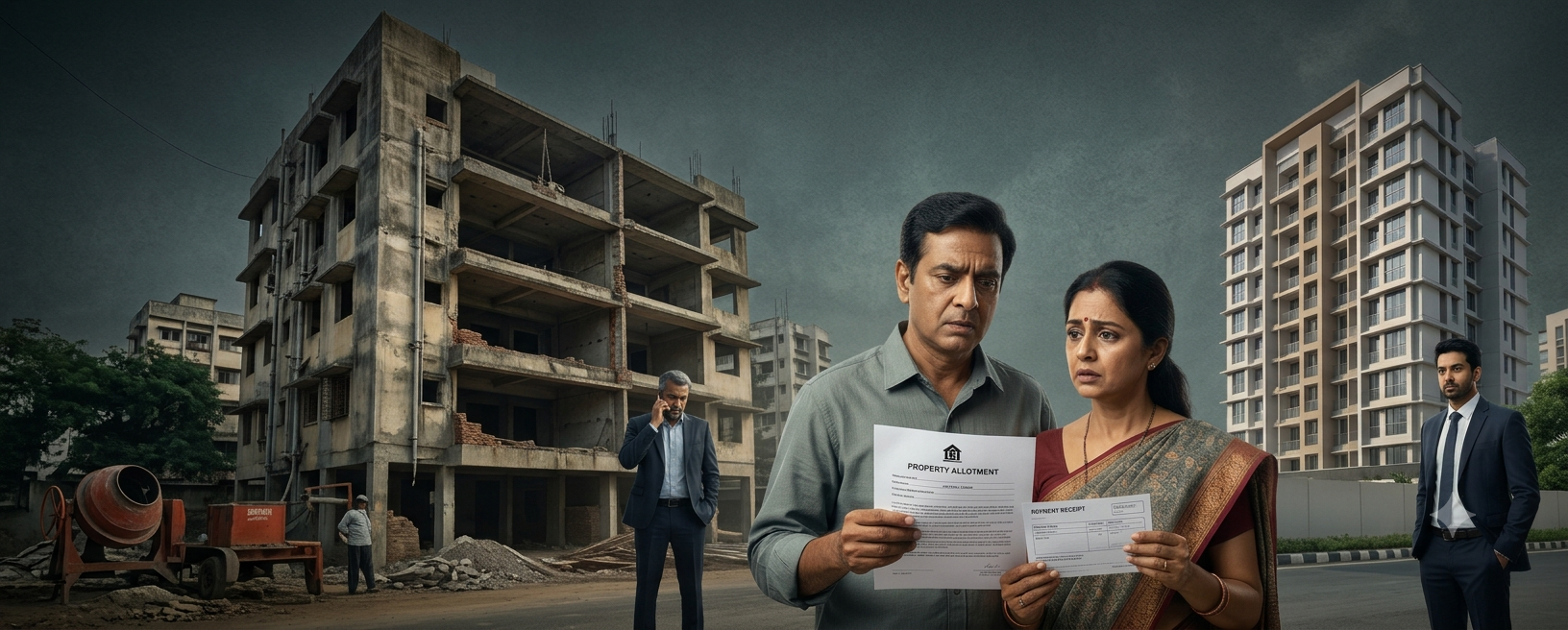
A new developer appointed to complete a stalled redevelopment project cannot automatically be made responsible for refunding money collected by the previous developer, the Bombay High Court has ruled, setting aside a MahaRERA order that had directed an incoming developer to pay interest to two homebuyers over a flat booking that had gone wrong years earlier. In a judgment delivered on November 5, 2026, a Division Bench of Justices Gautam A. Ankhad and Suman Shyam held that the new developer could not be made to shoulder the previous developer’s financial obligations when it had neither received the homebuyers’ money nor taken over the earlier developer’s rights and liabilities through a transfer or assignment under the Real Estate (Regulation and Development) Act, 2016.
The ruling came in a dispute involving the redevelopment of Samaj Darshan, a property in Kandivali West, Mumbai, owned by the Khambhati Modh Vanik Samaj trust. The case concerned Rs. 37 lakh paid by homebuyers Kinjal M. Karia and Mahesh Karia to the original developer, Jayant Mehta, proprietor of Bhakti Enterprises, for Flat No. 902. After the original developer failed to refund the money despite giving repeated undertakings, MahaRERA directed both the original and incoming developers to pay interest. The incoming developer, H. Rishabraj Developers, challenged that direction before the High Court.
The Court has now quashed the interest liability and consequential recovery proceedings against H. Rishabraj Developers. However, it has expressly clarified that the judgment does not absolve the original developer of the obligation to repay the homebuyers. The buyers remain free to pursue recovery of their dues, including interest, against the original developer and, if legally maintainable, the trust.
The redevelopment project and the original developer’s appointment
The property at the centre of the dispute belonged to Khambhati Modh Vanik Samaj, a charitable trust. It comprised land and a tenanted building containing 44 tenements. As the building had become dilapidated, the trust decided in 2011 to undertake redevelopment jointly with Jayant Mehta, who operated through Bhakti Enterprises.
The parties took steps towards redevelopment during 2013 and 2014. These included obtaining tenant consents, signing a Memorandum of Understanding on January 2, 2014, securing statutory permissions and taking steps towards demolition. The MOU recorded that the development rights were subject to permission from the Charity Commissioner. It also stated that Mehta alone would be responsible for claims made by any person against the trust.
On January 9, 2014, Mehta issued a letter of allotment for Flat No. 902 to Sanjay Khandelwal. Subsequently, on January 22, 2015, he issued a letter of allotment for the same flat to Kinjal and Mahesh Karia.
The Karias paid Rs. 37 lakh towards the flat. The Charity Commissioner granted sanction for the sale and development of the property under Section 36 of the Maharashtra Public Trusts Act, 1950, on June 8, 2015. The trust thereafter executed a registered Development Agreement and an irrevocable Power of Attorney in favour of Mehta on December 7, 2015, authorising him to undertake development-related activities and execute documents.
Original developer could construct only seven floors
The redevelopment did not progress as planned. By 2017, the original developer had constructed only seven floors. Disputes arose between the trust and Mehta over alleged breaches of the Development Agreement.
On July 15, 2017, the trust terminated the Development Agreement and invoked the arbitration clause to resolve its disputes with the developer.
There was also a dispute over the project’s MahaRERA registration. Mehta had registered the project on August 31, 2017, showing himself and the trust as co-promoters. The trust subsequently maintained that this had been done without its knowledge and that it had not executed documents relating to the registration.
The dispute between the trust and the original developer eventually went to arbitration. An arbitral award dated May 12, 2025, directed Mehta to pay Rs. 5,39,50,173 to the trust, together with interest at 10% per annum from the date of the award until payment. Mehta challenged the award under Section 34 of the Arbitration and Conciliation Act, 1996. That challenge was pending before the High Court, although no stay had been granted against enforcement of the award.
Homebuyers approach MahaRERA seeking refund of Rs. 37 lakh
While the dispute between the trust and the original developer was unfolding, the Karias approached MahaRERA.
On March 6, 2018, they filed a complaint seeking a refund of the Rs. 37 lakh paid towards Flat No. 902, along with interest and compensation.
MahaRERA disposed of the complaint on May 17, 2018, after recording that the homebuyers had agreed to accept the principal amount without interest. Mehta submitted a written undertaking that he would refund the entire amount through pay orders according to an agreed payment schedule. The homebuyers signed the undertaking and agreed to the payment dates.
The complaint was disposed of on the basis of this undertaking.
However, the original developer defaulted within two weeks, failing to honour even the first instalment of the repayment schedule.
The Karias then filed a Review-cum-Execution Application on June 12, 2018, seeking further relief, including interest and compensation. During the hearing on July 9, 2018, Mehta furnished another undertaking, promising to repay Rs. 37 lakh on or before July 27, 2018.
That undertaking was also not honoured.
On August 13, 2018, MahaRERA rejected the request to review its May 17 order but partly allowed the application by directing the Collector to issue a recovery warrant against the original developer for the interest amount. Subsequently, on July 9, 2019, the Tahsildar caused a charge or encumbrance of Rs. 37 lakh, representing the principal amount due to the homebuyers under the MahaRERA orders, to be recorded on the property card of the land.
The original developer had, therefore, repeatedly accepted his repayment obligation but had failed to fulfil it.
Court Receiver steps in and a new developer is appointed
The dispute between the trust and Mehta continued. On February 21, 2019, the two parties arrived at consent terms before the High Court in the arbitration proceedings. However, the original developer continued to default on his obligations.
The trust then sought the appointment of a Court Receiver to take over the project and permit the appointment of a new developer.
By orders dated November 26, 2020, and December 11, 2020, the High Court directed the Court Receiver to take possession of the property and hand it over to the trust so that a new developer could be appointed to complete the redevelopment.
It was against this background that H. Rishabraj Developers entered the picture.
On July 7, 2021, the trust executed a fresh registered Development Agreement with H. Rishabraj Developers, giving it the rights to develop and sell the property. The new developer subsequently completed the redevelopment under this agreement.
An important distinction in the case was that the incoming developer was appointed through a fresh agreement following court proceedings. It was not appointed through a transfer or assignment of the original developer’s rights and liabilities to it.
MahaRERA’s order directing the new developer to pay interest
Meanwhile, the Karias had challenged MahaRERA’s August 13, 2018 order before the Appellate Tribunal. On July 30, 2021, the Tribunal partly set aside that order and remanded the matter to MahaRERA for fresh consideration of the Review-cum-Execution Application.
The incoming developer was called upon to attend the hearing after the matter was remanded. It appeared through an advocate and filed written submissions. However, it was never formally impleaded as a party to the original complaint, the review-cum-execution proceedings or the appeal.
Separately, in Suo Motu Case No. 215 of 2022, MahaRERA passed an order on January 21, 2022, permitting the project to be registered in the name of H. Rishabraj Developers. Since the change of promoter was taking place pursuant to the High Court’s directions in the Section 9 proceedings, MahaRERA waived the requirement of obtaining allottee consents for the change.
The registration order also recorded that the new developer would not be liable for past liabilities or claims relating to the project. The order was subsequently rectified in December 2022 to clarify the position regarding the trust as well. These orders were not challenged by the parties. H. Rishabraj Developers received its RERA registration certificate on February 7, 2022.
However, on March 21, 2022, MahaRERA passed another order allowing the Karias’ Review-cum-Execution Application. It directed Jayant Mehta and H. Rishabraj Developers, described as the new promoter, to pay interest on the Rs. 37 lakh from May 17, 2018, until the amount was actually realised by the homebuyers.
MahaRERA rejected the homebuyers’ claim for compensation because documentary proof of mental agony had not been submitted.
The direction to the incoming developer was significant because it made the new developer responsible for interest running from a date more than three years before it had entered the project.
New developer’s bank accounts attached
Following the March 21, 2022 order, the revenue authorities initiated recovery proceedings against H. Rishabraj Developers.
Distraint orders dated March 23, 2022, and May 30, 2022, were issued under Section 180 of the Maharashtra Land Revenue Code, 1966. The developer’s bank accounts with Cosmos Co-operative Bank were attached and frozen, restricting payments to persons other than the homebuyers.
The High Court granted interim protection on June 29, 2022, directing that no further steps be taken against the developer under the distraint orders.
On November 26, 2024, the MahaRERA Adjudicating Officer nevertheless issued a recovery warrant against the original and incoming developers for the principal amount and interest accrued up to that date. The High Court stayed the recovery warrant qua H. Rishabraj Developers on January 10, 2025.
The incoming developer challenged the MahaRERA order dated March 21, 2022, through Writ Petition No. 894 of 2024. It also challenged the consequential recovery and distraint proceedings through Writ Petition No. 7618 of 2022.
Homebuyers argued that the new developer had taken over the project with knowledge of old liabilities
Before the High Court, the homebuyers opposed the incoming developer’s challenge.
Their argument was that H. Rishabraj Developers had taken over the redevelopment project with knowledge of the earlier liabilities and encumbrances. They contended that the trust and the new developer were liable as co-promoters and that the obligations of the previous developer could not simply be left behind when a new developer took over the project.
They relied on Sections 2(zk), 15 and 18 of RERA.
The homebuyers argued that Section 15 governed the transfer of a promoter’s rights and liabilities and required the incoming promoter to discharge pending obligations. They also relied on Section 18, which provides for refund and interest in specified circumstances when a promoter fails to complete a project or give possession.
They further argued that the incoming developer had been notified of the proceedings, had appeared through an advocate and had filed written submissions. Therefore, according to them, it could not claim that it had not been made a party.
The original developer also opposed the new developer’s challenge. His counsel argued that around Rs. 32 crore had been spent on construction and that the trust and the incoming developer could not retain the benefit of that construction while refusing to take responsibility for the associated liabilities.
The trust, on the other hand, supported the incoming developer. It argued that the new developer had been appointed through a fresh Development Agreement following the High Court’s intervention and that the original developer had repeatedly undertaken to repay the Karias.
High Court: A person cannot be made financially liable without being impleaded
One of the first issues considered by the Division Bench was whether MahaRERA could direct H. Rishabraj Developers to pay interest when it had not been formally impleaded as a party to the original complaint or the Review-cum-Execution Application.
The Court found that the incoming developer was not a party to the original complaint filed by the Karias on March 6, 2018. It was also not a party to the Review-cum-Execution Application filed on June 12, 2018, the appeal before the Appellate Tribunal or the proceedings after the matter was remanded.
The cause title of MahaRERA’s March 21, 2022 order named the original developer and the trust as respondents. It referred to H. Rishabraj Developers merely as the new promoter whose advocate had appeared.
No application had been made to formally implead the incoming developer, and the Review-cum-Execution Application had not been amended to seek any relief against it.
The Court held that merely issuing a notice to a person, allowing that person to attend a hearing and accepting written submissions does not make that person a party to the proceedings.
An adjudicating authority cannot impose financial liability on someone who has not been formally made a party and against whom no specific case has been pleaded. The incoming developer had not been given a clear opportunity to answer the nature of the liability being sought to be imposed on it under Sections 2(zk), 15 or 18 of RERA.
The Bench held that this non-joinder was fatal and that the MahaRERA order was unsustainable against the new developer on this ground alone.
Original developer alone had undertaken to refund the Rs. 37 lakh
The High Court then examined who was actually responsible for returning the money.
It noted that MahaRERA’s original order dated May 17, 2018, was clear. The Karias had sought a refund from Jayant Mehta, and Mehta had furnished a written undertaking to repay the Rs. 37 lakh. The homebuyers had agreed to accept the principal amount without interest at that stage.
The original developer subsequently furnished another undertaking on July 9, 2018, promising to repay the amount by July 27, 2018.
The Court also noted that Mehta had filed affidavits dated April 10, 2018, and April 23, 2018, before the High Court in an anticipatory bail application, undertaking to repay amounts to investors, including the Karias.
Thus, the original developer had accepted his repayment obligation on at least three occasions.
The Bench held that the liability to pay interest could only be fastened on the party responsible for paying the principal amount. Since the original developer had received the Rs. 37 lakh and had undertaken to refund it, the liability belonged to him.
The Court observed that a default committed by the original developer could not retrospectively be transferred to a third party that entered the project three years after the original refund order.
Section 2(zk): A new promoter does not automatically inherit every old liability
The Court then examined the definition of a promoter under Section 2(zk) of RERA.
This provision has a wide scope. Its explanation provides that where the person constructing a building and the person selling apartments are different, both can be treated as promoters and made jointly responsible for the functions and responsibilities under the Act.
The homebuyers relied on this provision to argue that the new developer could be held liable as a promoter of the same redevelopment project.
However, the High Court explained that the purpose of the provision is to prevent persons performing substantive promoter functions from escaping statutory responsibility merely because different persons undertake different parts of the same transaction.
It does not mean that every financial liability of one promoter automatically passes to a developer who subsequently undertakes development of the same property.
The Court distinguished the earlier judgment in Wadhwa Group Housing Pvt. Ltd. v. Vijay Choksi, explaining that the earlier case dealt with liabilities between co-promoters in a different factual situation. The present case involved termination of one Development Agreement and appointment of another developer through a court-directed process on a fresh basis.
The issue was not whether the trust and the original developer could be treated as co-promoters. The question was whether the incoming developer could be made responsible for a refund obligation that had already crystallised against the original developer.
The Bench answered that question in the negative.
Section 15 of RERA: Was there a transfer of the old developer’s rights and liabilities?
Section 15 of RERA was one of the most important legal provisions examined in this case.
Under Section 15(1), a promoter cannot transfer or assign its majority rights and liabilities in respect of a real estate project to a third party without prior written consent from two-thirds of the allottees, excluding the promoter, and prior written approval of the Authority.
Section 15(2) provides that when such a transfer or assignment takes place, the incoming promoter must independently comply with pending obligations under RERA, its rules and regulations, as well as pending obligations under agreements for sale entered into by the previous promoter with the allottees.
The homebuyers argued that the change of developer in Samaj Darshan attracted this provision and that the incoming developer had to discharge the previous developer’s liabilities.
The High Court rejected this interpretation on the facts of the case.
The Development Agreement between the trust and Jayant Mehta had been terminated on July 15, 2017. The High Court subsequently directed the Court Receiver to take possession of the property and hand it over to the trust so that a new developer could be appointed.
The trust then executed a fresh Development Agreement with H. Rishabraj Developers on July 7, 2021.
The incoming developer did not derive its rights from the original developer. It obtained its development rights through a fresh agreement with the trust following the Court’s directions. There was no privity of contract between the incoming and outgoing developers.
The Court also noted that MahaRERA had waived the requirement of obtaining allottee consent for the appointment of the new developer precisely because the change was taking place through the court-directed process.
There was another important distinction. Even where Section 15(2) applies, it refers to pending obligations under the Act and under agreements for sale entered into by the erstwhile promoter.
In this case, the refund obligation had already been crystallised against Mehta through his own undertaking and the MahaRERA proceedings. The Court held that this was the original developer’s debt, not a pending project obligation that automatically passed to whoever completed the building.
Consequently, Section 15 could not be used to make H. Rishabraj Developers responsible for the original developer’s refund liability.
Section 18: The new developer had not received the homebuyers’ money
The Court also rejected the homebuyers’ reliance on Section 18 of RERA.
Section 18 provides for the return of amounts received by a promoter, along with prescribed interest and compensation in specified circumstances where the promoter fails to complete the project or is unable to give possession in accordance with the agreement for sale, or discontinues its business as a developer for the reasons specified in the provision.
The High Court explained that Section 18 compensates an allottee for the use of their money by the promoter who received and held it.
In this case, the Rs. 37 lakh had been received and retained by Jayant Mehta. H. Rishabraj Developers had not received any part of that money.
The MahaRERA order had directed the incoming developer to pay interest from May 17, 2018, even though it had entered the project only in 2021.
The Court held that, in these circumstances, Section 18 could not be applied against the incoming developer to make it discharge the original developer’s refund obligation.
Knowledge of old liabilities does not mean that the new developer has accepted them
Another argument advanced by the homebuyers was that the incoming developer had taken over the project with full knowledge of the existing liabilities and encumbrances.
The High Court rejected this argument as well.
It held that knowledge of another person’s liability does not amount to taking over that liability.
For the incoming developer to become responsible for the original developer’s refund obligation, there had to be a contract, a statutory provision or an order of a competent authority making it liable. The Court found no such basis in the present case.
This is an important distinction for redevelopment projects where a new developer is appointed after the previous developer’s agreement is terminated. Awareness of a dispute or a claim connected with the property, by itself, does not establish that the incoming developer has agreed to pay the previous developer’s debts.
What about the Rs. 32 crore spent by the original developer?
The original developer had argued that it had spent approximately Rs. 32 crore on construction and that the incoming developer and the trust could not retain the benefit of the construction while denying responsibility for the liabilities associated with the project.
The High Court did not accept this argument as a reason to impose the Karias’ refund claim on H. Rishabraj Developers.
It held that any claim relating to the construction expenditure was a dispute between the original developer and the trust. That dispute was already the subject of the arbitral award dated May 12, 2025, and the pending challenge to that award.
It could not be used to transfer the original developer’s refund obligation to the incoming developer.
The Bench also emphasised that the party which had received and retained the Rs. 37 lakh since 2015 was the original developer. Having repeatedly undertaken before MahaRERA and the High Court to repay the amount, Mehta could not argue that another party should pay the principal or the interest arising from his defaults.
The Court further clarified that its conclusion did not depend on the final outcome of the challenge to the termination of the original Development Agreement. The incoming developer had been appointed after the High Court’s orders directing the Court Receiver to hand over the property to the trust for appointment of a new developer. The pending arbitration dispute would govern the rights between the trust and the original developer.
Court leaves important questions open
The judgment did not decide every dispute surrounding the original allotment.
The incoming developer had argued that the commencement certificate covered construction only up to the eighth floor when Flat No. 902 was allotted on the ninth floor. It therefore questioned the validity of the allotment and the homebuyers’ status.
The trust also argued that the allotment letter had been issued before the Charity Commissioner’s sanction under Section 36 of the Maharashtra Public Trusts Act and that the trust had not signed the allotment letter.
The original developer disputed this position, arguing that the statutory sanction was a formality and that steps towards redevelopment had already been taken.
The homebuyers, meanwhile, maintained that the trust was a co-promoter and that the new developer and trust were answerable for the project’s obligations.
The High Court expressly left these questions open for appropriate proceedings. It did not decide whether the allotment letter was valid, whether the trust was a co-promoter qua the homebuyers, or whether the trust could be held liable for any of the claims.
The Court also did not decide the broader question of whether MahaRERA has an inherent power to review its orders. The new developer had challenged MahaRERA’s power to review under Regulation 36 of the Maharashtra Real Estate Regulatory Authority (General) Regulations, 2017. However, the Bench found that there were no pleadings or prayers seeking to declare the regulation ultra vires the RERA Act. It therefore treated the regulation as operative for the purposes of the proceedings and did not decide the wider legal question.
High Court quashes MahaRERA’s order and bank attachment against the new developer
After examining the facts and the statutory provisions, the Bombay High Court allowed both writ petitions.
The Court quashed MahaRERA’s order dated March 21, 2022, insofar as it directed recovery from H. Rishabraj Developers. It also set aside the consequential recovery proceedings and the distraint orders dated March 23, 2022, and May 30, 2022, which had resulted in the attachment and freezing of the developer’s bank accounts.
The Court held that once the underlying order imposing liability on the incoming developer was found unsustainable, the consequential attachment and recovery orders could not survive independently.
However, the Court made an important clarification in paragraph 41 of the judgment. The order and recovery warrants were quashed only to the extent that they sought recovery from H. Rishabraj Developers.
The judgment does not absolve Jayant Mehta, the original developer, of his obligations under the undertakings given before MahaRERA and the High Court. The Karias are free to pursue remedies against Mehta and, if legally maintainable, the trust, to recover all their dues, including interest.
The Court kept the rights and contentions of the homebuyers, the original developer and the trust open in this regard.
What does this judgment mean for homebuyers and redevelopment projects?
The ruling is significant for redevelopment projects in which an original developer is removed, a Development Agreement is terminated and a new developer is appointed to complete the work.
It establishes that the appointment of a new developer does not, by itself, make that developer responsible for every financial liability incurred by the previous developer.
The distinction between a transfer or assignment under Section 15 of RERA and a fresh appointment following termination of an earlier Development Agreement is central to the judgment.
For homebuyers, the decision also highlights the importance of identifying the entity that received their money, the terms of the agreement or allotment, the undertakings given and the legal basis on which a claim is made against a subsequent developer.
The judgment should not, however, be read as a blanket exemption for every incoming developer. Where rights and liabilities are transferred or assigned in a manner covered by Section 15, the statutory consequences may be different. Similarly, a new developer may have obligations arising from its own agreements, conduct or statutory responsibilities.
The Bombay High Court’s decision is confined to the facts before it: the original developer had received the homebuyers’ money, repeatedly undertaken to refund it, and defaulted; the original Development Agreement had been terminated; and the incoming developer was appointed through a fresh agreement following the High Court’s intervention.
For the two homebuyers in this case, the fight to recover the Rs. 37 lakh and interest is not over. What the Court has decided is that the incoming developer cannot be made to pay the old developer’s debt merely because it completed the redevelopment project.
Also Read: New Builder Must Also Pay Old Builder’s Rs 38 lakh Refund to Homebuyer: MahaRERA