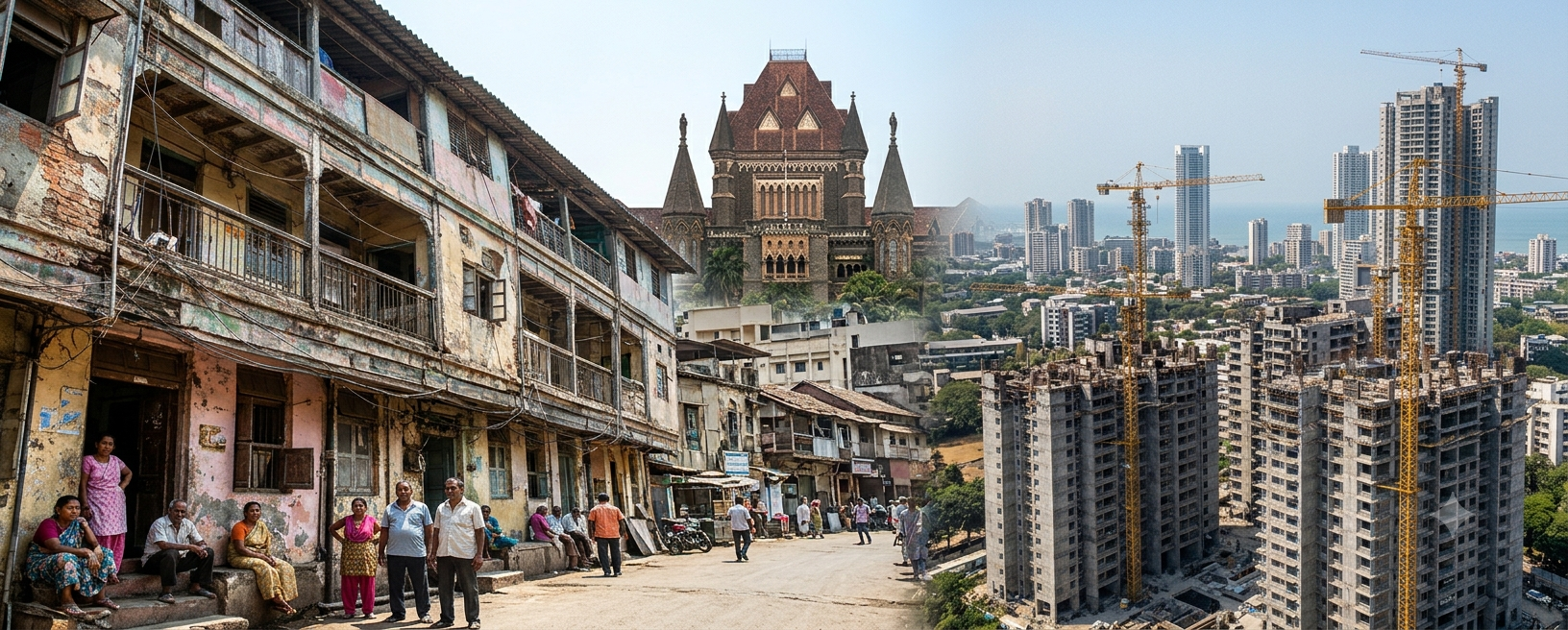
In a significant ruling that could accelerate the redevelopment of thousands of old and dilapidated buildings in Mumbai’s Island City, the Bombay High Court has held that developers are entitled to incentive Floor Space Index (FSI) for rehabilitating occupants of non-cessed structures on mixed plots, provided the land under those non-cessed structures is less than 45% of the total plot area.
The judgment, delivered on 5 November 2026 by a Division Bench of Justices Suman Shyam and Gautam A. Ankhad in Writ Petition (L) No. 23230 of 2026 (Earth Graphics & Anr. vs State of Maharashtra & Ors.), interprets clause (19) of Regulation 33(7) of the Development Control and Promotion Regulations for Greater Mumbai, 2034 (DCPR 2034). It effectively removes a long-standing practical obstacle that often stalled redevelopment proposals where cessed and non-cessed structures stood side by side.
What the Court Decided
The Court set aside a State Government clarification dated 24 August 2026 and the consequent rejection by the Municipal Corporation of Greater Mumbai (MCGM) dated 31 August 2026. It directed the authorities to process and approve the petitioners’ redevelopment proposal for the property at C.S. Nos. 683, 684 and 685, Girgaon Division, R.K. Wadi, V.P. Road, and to grant the benefit of incentive FSI for the land component under the non-cessed structures as per Regulation 33(7)(19).
The property measures about 2,882.32 sq m. All structures were built before 1940. It houses 115 residential and 46 commercial tenants/occupants. The land under the non-cessed structures is only 15.91% of the total plot area — well below the 45% threshold.
Why This Matters for Tenants of Old Buildings
For decades, Regulation 33(7) has been the primary incentive route for the reconstruction of cessed buildings in the Island City (structures existing before 30 September 1969 on which repair cess was levied). It offers higher FSI — either 3.00 on the gross plot or the area required for rehabilitation of existing occupants plus incentive FSI, whichever is higher — to make redevelopment financially viable.
A persistent problem on many plots, especially in dense areas such as Girgaon, Grant Road, Parel and parts of South Mumbai, is that cessed and non-cessed structures stand next to each other on the same or adjoining plots. Authorities had been denying incentive FSI on the area needed to rehabilitate non-cessed occupants, treating them under ordinary development rules. This reduced overall project viability and frequently turned non-cessed tenants into a perceived hurdle, delaying or killing redevelopment proposals.
The High Court has now clarified that clause (19) of Regulation 33(7) expressly extends the rehabilitation framework (including the benefits under clause 2) and the associated incentive FSI to eligible non-cessed structures on such mixed plots, provided the land component under the non-cessed structures does not exceed 45% of the total plot area. The non-cessed area is not to be deducted; FSI is to be calculated on the total plot.
In simple terms: on qualifying mixed plots, non-cessed tenants will no longer be viewed as an obstacle. Their rehabilitation will also attract the incentive FSI that makes the overall redevelopment workable. This is expected to remove one of the key commercial and procedural bottlenecks that has held up many Island City projects.
Scale of the Challenge in Island City
According to official and reported figures, the Island City has more than 13,091 cessed and non-cessed buildings, most of them over five decades old and many in a dilapidated condition. MHADA’s Mumbai Building Repairs and Reconstruction Board has been urging landlords and tenants of these buildings to come forward for redevelopment under the amended Section 79A of the MHADA Act and the incentives available under Regulations 33(7) and 33(9) of DCPR 2034.
A Bombay High Court-appointed panel has earlier noted that nearly four lakh tenants continue to live in around 12,500-plus cessed buildings, many of them structurally unsafe. MHADA has been conducting structural audits and has plans to inspect the bulk of these buildings. Areas with mixed cessed and non-cessed stock — common in older localities — have frequently seen redevelopment proposals stall precisely because of the lack of clarity (or adverse interpretation) on incentive FSI for the non-cessed component.
The present ruling addresses this gap. By confirming that non-cessed structures within the 45% land limit are to be treated like the cessed component for the purpose of Regulation 33(7) FSI, the Court has strengthened the commercial viability of composite redevelopment schemes. This is expected to encourage more developers and societies to take up projects that were earlier considered unviable or too complicated.
Practical Impact
- Tenants of both cessed and non-cessed structures on qualifying mixed plots stand a better chance of timely rehabilitation in safer, modern buildings.
- Developers can now structure proposals with greater certainty on the incentive FSI component, improving project economics.
- Societies and occupants who had been waiting because the non-cessed portion was treated as a liability may see renewed interest from developers.
- The ruling is limited to cases where structures existed before 30 September 1969 and the non-cessed land component is ≤45% of the total plot. Other conditions of Regulation 33(7) continue to apply.
The Court noted that the Mumbai Building Repairs and Reconstruction Board itself had earlier (in October 2021) confirmed eligibility in the present case because the non-cessed land component was within the 45% limit. The subsequent contrary clarification by the State was held to be unsupported by the plain language of clause (19).
For the thousands of families still living in old, often unsafe buildings across the Island City, this order offers a clearer path forward. Redevelopment of mixed plots is now less likely to be stalled solely because of the presence of non-cessed structures next to cessed ones.
Also Read: Bombay High Court Orders ₹7 Lakh Costs Over Housing Society’s Redevelopment Delay