At a glance
- India’s live data centre capacity has already crossed 1.6 GW as of June 2026 — about 5 times the 2019 level.
- JLL projects capacity will jump to 6 GW by 2029, adding 4.4 GW in three years.
- The build-out needs USD 110 billion across the value chain and 49 million sq ft of real estate.
- Split of that capital: $4 bn for construction, $18 bn for MEP (power, cooling, plumbing), $88 bn for IT equipment.
- H1 2026 absorption was 101 MW, more than 20% above the three-year H1 average; vacancy is a record-low 2.8%.
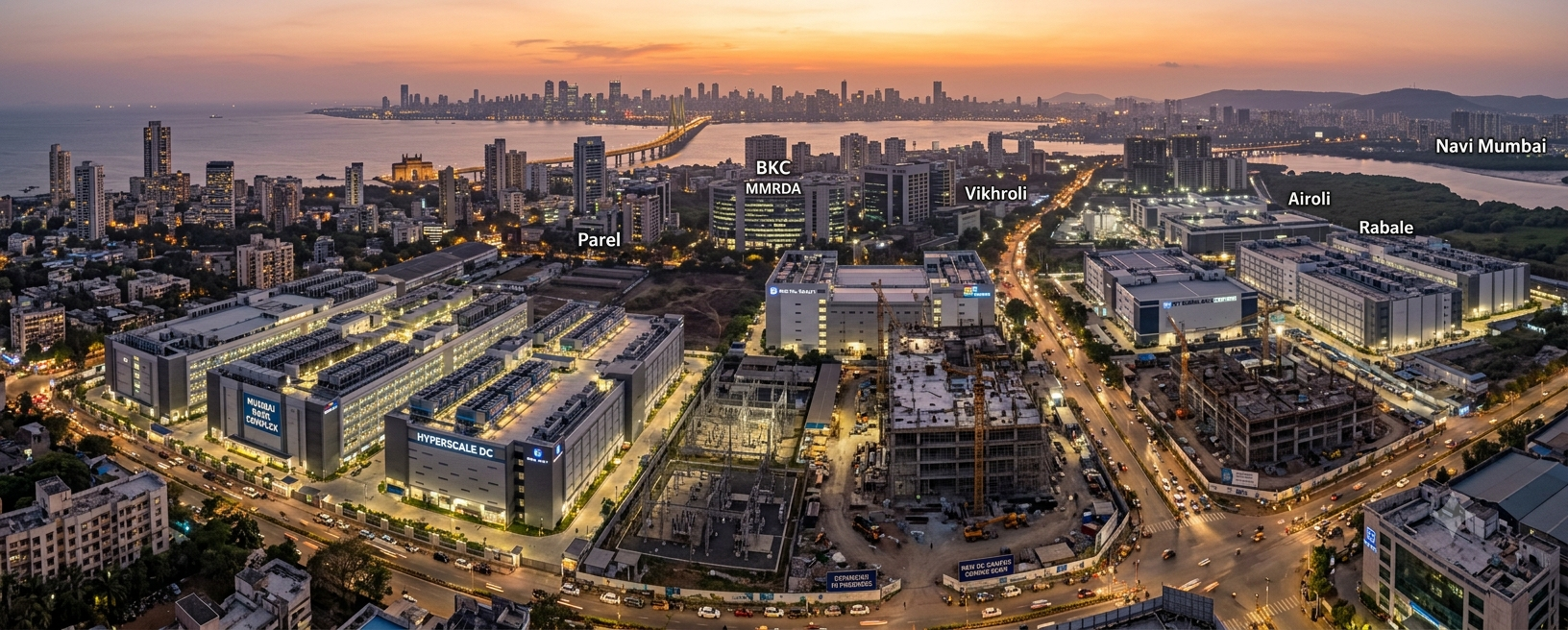
- Mumbai is slated for 35% of the 4.4 GW pipeline; Hyderabad 24%, Visakhapatnam 14%, Chennai 9%.
- Hyperscalers may self-build 1.4 GW by 2029. A 20-year tax holiday till 31 March 2047 has pulled in over $50 bn of foreign commitments.
India’s data centre market is no longer a niche industrial story. It is turning into one of the largest real estate and infrastructure build-outs of this decade.
A new JLL assessment says capacity will surge from 1.6 GW in June 2026 to 6 GW by 2029, making India Asia’s fastest-growing digital infrastructure market. The trigger is not just cloud storage. It is AI workloads — high-density computing that needs more power, more cooling, more land and far more capital than a conventional office park.
For developers sitting on large land parcels, for investors hunting yield beyond housing and malls, and for homebuyers watching how industrial demand reshapes city fringes, this is the number that matters: 49 million sq ft of new real estate and USD 110 billion across construction, plant and IT kit.
“India’s data centre landscape is undergoing a fundamental transformation unprecedented in scale and ambition. The convergence of landmark tax incentives with massive hyperscale investments for AI-driven infrastructure requirements positions India as a strategic global hub for digital innovation,” said Rachit Mohan, Managing Director, Data Centre Leasing, APAC, JLL. “With 4.4 GW of new capacity requiring USD 110 billion in capital by 2030, we are witnessing the creation of an entirely new digital infrastructure ecosystem that will reshape India’s technology landscape and drive economic growth for decades to come.”
From 1.6 GW to 6 GW: what the leap actually means
JLL’s mid-2026 stock of 1.6 GW is already five times the 2019 base. The next jump is steeper. 4.4 GW of new capacity is expected by 2029.
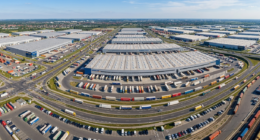
That is not incremental warehouse-style growth. AI racks draw far more power per square foot than traditional servers. Operators therefore want large, power-ready campuses, not scattered floors in IT parks. That is why the sector is pulling land on city outskirts, industrial corridors and coastal nodes rather than competing only for CBD office space.
H1 2026: demand is running ahead of supply
The first half of 2026 showed how tight the market already is:
- 101 MW absorbed in January–June — more than 20% above the three-year H1 average.
- 85 MW delivered, mostly in Mumbai and Chennai.
- Vacancy down to 2.8%, a record low, because a large share of new supply is pre-committed rather than built on speculation.
JLL’s mid-year note also flags that pre-committed hyperscale capacity made up a very large share of absorption, driven by high-density AI computing. For landlords, that means lease-up risk is lower than in conventional commercial real estate — if the site has power, fibre and approvals.
The $110 billion stack — and the 49 million sq ft realty piece
JLL breaks the capital need as follows:
- USD 4 billion — real estate construction (the shell, land development, campus works).
- USD 18 billion — mechanical, electrical and plumbing: transformers, switchgear, chillers, liquid cooling, diesel/backup, water systems.
- USD 88 billion — IT equipment: servers, racks, networking.
The $4 billion construction line is the part that directly hits developers, contractors, steel-cement suppliers and landowners. The $18 billion MEP line is where specialised industrial contractors and power-equipment makers come in. The $88 billion IT line is largely imported or assembled kit — but it still needs buildings that can take the load.
49 million sq ft is the built-up real estate JLL attaches to this cycle. That is not 49 million sq ft of luxury towers. It is powered shells, technical buildings, substations, admin blocks and support facilities on large plots. For context, that is several times the annual Grade-A office delivery of a single metro — concentrated in a handful of hubs.
Hyperscalers will build a lot of it themselves
Global cloud and AI players are not only leasing from Indian operators. JLL says they will self-build nearly 30% of new capacity.
By 2029, hyperscale self-build is expected to deliver 1.4 GW. That changes the real estate model:
- Some campuses will be build-to-suit on land sold or leased by developers.
- Some will be powered-shell deals — the developer delivers land, structure and basic utilities; the hyperscaler fits out the hall.
- Established markets such as Mumbai and Chennai stay core. Hyderabad and Visakhapatnam are being talked about as gigawatt-scale hubs, not just secondary cities.
Self-build also means longer land-banking, heavier power reservations and fewer small plot deals. Investors looking at this sector need to think in 50–200 acre campus logic, not 2-acre IT building logic.
Policy tailwind: 20-year tax holiday till 2047
JLL points to the Union Budget 2026-27 incentive: a 20-year tax holiday for foreign cloud service providers, running till 31 March 2047.
The consultancy says this has already pulled in over USD 50 billion in foreign capital commitments. The policy pitch is simple: India becomes a routing and processing hub for global AI and cloud traffic, while long-horizon capital gets a clearer tax path.
For real estate, tax holidays do not create FSI. They do something else — they make 15–20 year campus investments bankable. That is when developers can justify buying raw land, waiting for transmission lines, and signing 10–15 year leases.
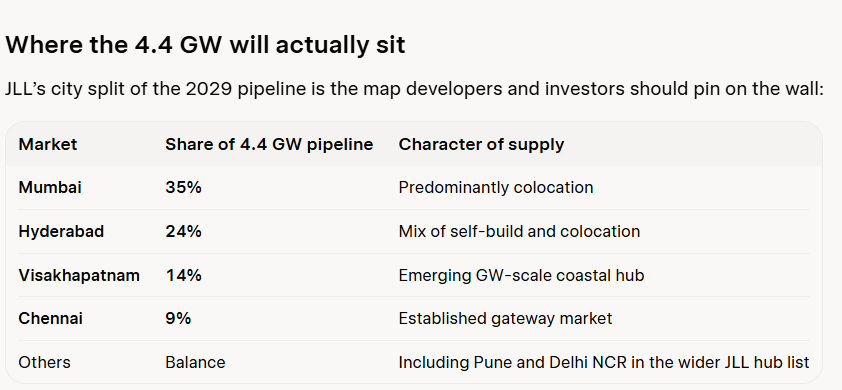
Mumbai remains the commercial and connectivity anchor — financial capital, dense fibre, subsea cable access, and the deepest operator ecosystem. That is why MMR industrial belts, Navi Mumbai, and large township/industrial land banks keep showing up in data-centre conversations.
Hyderabad is the cost-and-policy challenger: large parcels, state facilitation, and mixed self-build plus colo.
Visakhapatnam is the coastal dark horse — land, ports, and planned international connectivity.
Chennai holds its gateway role with subsea cables and a mature operator base.
JLL’s broader hub list also flags Pune as an AI compute node and Delhi NCR for sovereign cloud — useful for investors who do not want a single-city bet.
Power is the real bottleneck — nuclear and SMRs are now part of the story
A data centre without assured megawatts is just an empty shed. JLL links the next wave to:
- State efforts to strengthen grid transmission.
- Renewable energy offtake and green-tariff incentives.
- India’s nuclear target of 22.38 GW by 2031-32 and 100 GW by 2047, as baseload for always-on AI halls.
- Small Modular Reactors (SMRs) by 2033, which JLL flags as a future option for off-grid or campus-scale power.
Cooling is changing too. Liquid cooling, higher renewable mix and lower Power Usage Effectiveness (PUE) are becoming design defaults, not CSR slides. That raises capex per MW but is what hyperscalers now underwrite.
For landowners near substations, upcoming transmission corridors or renewable parks, this is the new “location, location, location.” A plot without a power story will struggle to enter this pipeline.
DPDP rules: compliance becomes a demand driver
The Digital Personal Data Protection (DPDP) framework, with full compliance required by May 2027, is another demand layer.
JLL says the rules — breach reporting, tighter security, and more localised processing — will push sovereign / compliant capacity, especially in BFSI, healthcare and technology. That favours operators who can prove Indian-soil processing, audit trails and physical security — not just cheap racks.
For the real estate side, that means more demand for facilities that can be certified, segregated and contractually ring-fenced, rather than generic multi-tenant halls.
What this means for developers, investors and homebuyers
Developers
This is not a substitute for housing. It is a parallel industrial-commercial vertical: large land, heavy power, long leases, specialised MEP. Players who already control industrial land, township leftovers, or logistics parks near fibre and grid nodes are best placed to sell, JV or build powered shells. Execution risk is high — environment, transmission, water and construction quality can stall a campus for years.
Investors
The $110 billion headline is not all real-estate IRR. Most of it is servers. The investable realty slice is the $4 billion construction plus land value and the long-lease income on colo campuses. Yields can look attractive versus vacant Grade-A offices, but the tenant universe is small and power risk is real. Treat this as infrastructure, not as another mall cycle.
Homebuyers and housing societies
Data centres rarely sit inside a residential society. They do, however, bid for the same fringe land, water and power that townships want. In MMR, Hyderabad and Chennai peripheries, expect more industrial-zoning pressure, higher values on large plots, and political fights over power allocation. The upside for nearby housing is jobs and infrastructure; the downside is strain on local utilities if planning is sloppy.
Broader economy
JLL notes ripple effects in power generation, telecom, manufacturing and skilled technical hiring. That is the public-policy case states are selling when they clear land and transmission for GW-scale parks.
Bottom line
JLL’s message is blunt: AI has turned Indian data centres from a 1.6 GW niche into a 6 GW, $110 billion, 49-million-sq-ft build-out by 2029. Mumbai still leads on share. Hyderabad and Visakhapatnam are the new scale bets. Tax holidays and DPDP rules are pulling foreign capital. Power, not just land, will decide who actually delivers.
For India’s real estate audience, the story is no longer “IT parks and SEZs.” It is who owns the next power-ready campus — and who is left holding land that cannot get a megawatt.
Also Read: Lodha Eyes Rs 30 Crore Per Acre Land Sales in Palava Data Center Park Amid AI Boom