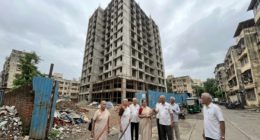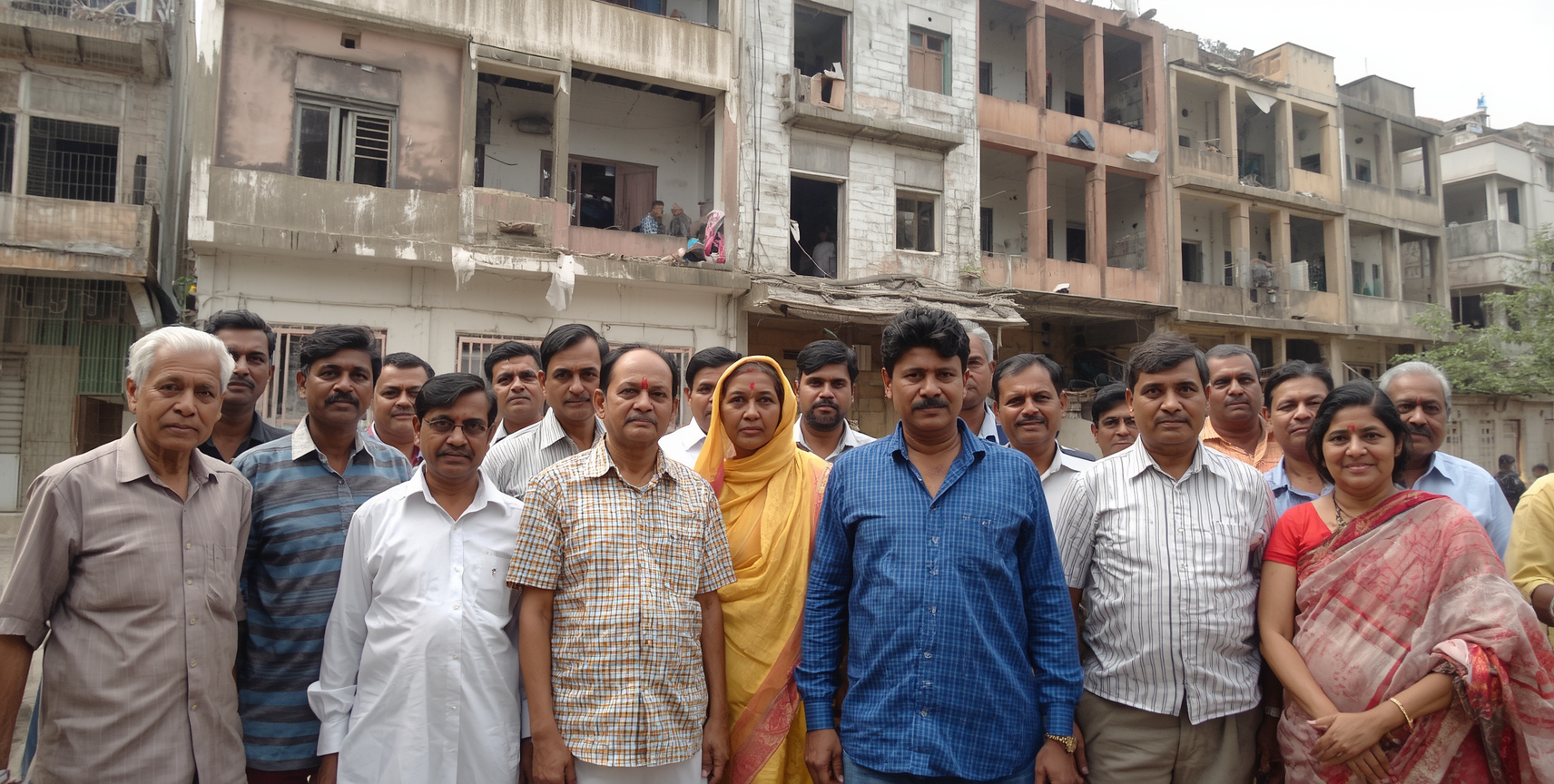

In a landmark judgment that puts humanity at the heart of redevelopment law, the Bombay High Court has ruled that the right of housing society members to live in safe, decent homes far outweighs a developer’s commercial interest in earning profits. Justice Sandeep V. Marne, in his order dated 24 April 2026, refused to stall the redevelopment of a 69-year-old society in Wadala and allowed it to proceed with a new developer.
The Case in Brief M/s. Pioneer Constructions (Petitioner) had been appointed as developer by Sahakarnagar Co-operative Housing Society Ltd. (Respondent) way back in 2013. Two Development Agreements were executed — in 2015 and again in April 2016 after renegotiation. The society comprises 826 residential flats, 19 shops and 24 stalls spread across 46 buildings constructed in 1957 on municipal land in Wadala, Mumbai. After 13 long years, not a single brick had been moved. The buildings had become dangerously dilapidated.
Frustrated by the endless delay, the society’s General Body terminated the developer’s appointment — first in September 2023, then again (after a brief withdrawal by the Managing Committee) in the AGM of 30 September 2024. In January 2026, the society appointed a new developer — M/s. Sugee Developers (Sugee Avenue Private Limited) — and was on the verge of finalising the Development Agreement.
Pioneer rushed to the Bombay High Court under Section 9 of the Arbitration & Conciliation Act, 1996, seeking an injunction to restrain the society from proceeding with the new developer. It also sought appointment of an arbitrator under Section 11.
Arguments Before the Court Senior Advocates Mr. D.D. Madon and Mr. Ashish Kamat, instructed by M/s. Diamondwala & Co., appeared for Pioneer Constructions. They argued that the Development Agreement had no termination clause, that past delays were condoned when the society withdrew the earlier termination in April 2024, and that the society had failed to obtain 70% member consents.
Opposing the petition, Advocate Mr. Chaitanya Chavan with Mr. Nikhil Jayakar (instructed by Mr. Ankit Dubey) forcefully submitted that the society had waited 13 years in vain. The developer had done virtually nothing beyond depositing ₹1 crore as earnest money. The members were living in life-threatening conditions in buildings nearly seven decades old.
The Court’s Humane and Powerful Reasoning Justice Sandeep V. Marne delivered a remarkably insightful and empathetic judgment. He observed:
“When rights of the society members to reside in safer and better homes is pitted against the right of the developer to make profits in the project, the former must prevail over the latter.”
The Court noted that the developer had suppressed material facts, including the State Minister’s order dated 17 December 2025 that had cancelled the revised NOC obtained by Pioneer. It also highlighted the developer’s shifting stands — first citing ill-health of a partner, then suddenly raising the issue of 70% consents which had never been pleaded earlier before the authorities.
Crucially, the judgment drew a clear distinction between ordinary commercial contracts and redevelopment agreements. Citing earlier Division Bench and Single Judge rulings (including Huges Real Estate Developers LLP and Ison Builders LLP), the Court held that a developer’s right to earn profits remains “imperfect” until he actually provides permanent alternate accommodation to the members. If the developer fails, the society is well within its rights to terminate the agreement and move ahead with a new developer.
Justice Marne emphasised the human cost:
“The members of the Society are languishing in old and dilapidated buildings constructed in the year 1957… Their wait cannot continue indefinitely.”
He categorically rejected the plea for interim injunction, holding that all three ingredients — prima facie case, irreparable injury, and balance of convenience — were against the developer. Granting stay would endanger lives and indefinitely delay a project that had already been pending for 13 years. Any monetary claim of the developer could be adequately addressed in arbitration.
Outcome of the Judgment
- The Section 9 petition was dismissed in its entirety. No injunction was granted.
- The society is now free to proceed with M/s. Sugee Developers and finalise the Development Agreement.
- Mr. Amrut Joshi, Advocate, was appointed as Sole Arbitrator to decide all disputes between the parties (including the validity of termination and Pioneer’s claim for damages).
- The developer’s last-minute request to extend the interim arrangement for one week was also rejected.
A Message for Every Housing Society in Maharashtra This judgment is a ray of hope for hundreds of societies trapped in decades-long redevelopment stalemates. It reaffirms a consistent principle evolved by the Bombay High Court: the safety and dignity of residents must always come before a developer’s profit motive. Societies need not remain “shackled” to a defaulting developer. Timely redevelopment is not just a commercial issue — it is a question of the right to life and shelter.
For builders, the message is equally clear: delay has consequences. Mere appointment as developer does not confer an indefeasible right to stall an entire society’s future indefinitely.