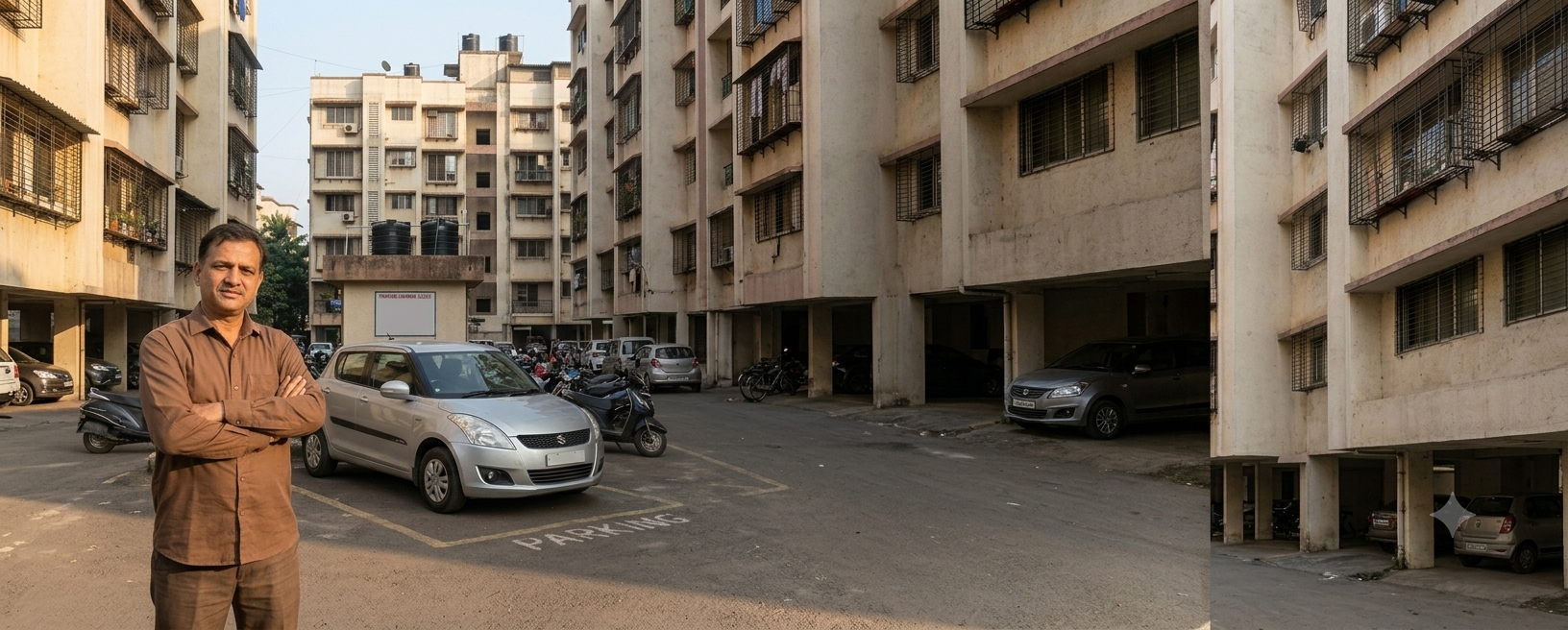

A Navi Mumbai housing society member who withheld monthly maintenance after accusing the managing committee of charging high parking fees — and a list of other irregularities — has been directed by the Co-operative Court, Thane, to pay ₹1,70,900. The court held that unproved allegations against office-bearers do not give a member the right to stop paying dues.
The dispute, CCT 132/2016 (CNR MHCO04-000148-2016), was filed on 5 December 2016 by Om Shree Krishna Co-operative Housing Society Ltd., Buildings F-10 to F-17, Plot 14, Sector 22, Koparkhairane. It was decided on 20 August 2026 by Judge Smt. B. P. Jadhav — after 9 years, 8 months and 15 days.
Society’s claim: years of unpaid maintenance
The society, registered under the Maharashtra Co-operative Societies Act, 1960, said member S. R. Bhandiwad, holder of Flat F-17/1:2, had defaulted on monthly maintenance.
It issued a first demand notice on 6 June 2015 for ₹77,040. Further notices followed on 12 July 2015 (₹79,503), 9 August 2015 (₹81,997), 20 September 2015 (₹1,18,085), 26 November 2015 (₹1,36,658) and 27 May 2016 (₹1,63,602). The society said the notices were served and acknowledged, but payment was not made.
Relying on bye-law 67, the society argued that common services, building upkeep and shared facilities are paid for from members’ maintenance. A member who enjoys those facilities cannot refuse to contribute. After a resolution dated 24 October 2015, the secretary was authorised to file the recovery dispute. The amount sued for was ₹1,70,900 plus interest at 21% per annum till realisation.
Member’s defence: parking fee and a longer list
Bhandiwad appeared and filed a written statement. He admitted membership and ownership of the flat. He did not accept the figure of ₹1,70,900 as correctly stated. He said he had not paid because of “many illegal activities” by the committee.
The allegations included:
- Using NMMC drinking water for additional FSI construction without NMMC permission
- Laying AC-sheet roofing on terraces of each building without NMMC permission
- Forgery and fraud in awarding work and paying the contractor
- Carrying out extra FSI work beyond plans approved by NMMC and CIDCO for buildings F-10 to F-16
- Repeated, unnecessary repairs and re-plastering of the overhead water tank “just making for financial outcome”
- Collecting parking charges in a high amount
- Issuing rental NOCs without police verification of tenants
He said these acts made him “conscious” about paying maintenance.
High parking charges sat on that list as one comparatively small, everyday grievance next to charges of unauthorised construction, misuse of water and alleged forgery. The court still had to decide whether any of this, proved or unproved, cancelled the duty to pay.
No evidence from the member
The society examined two secretaries — Sanjay Bhujbal and later Narayan Tukaram Jarange — and produced demand notices, bills, a statement of outstanding dues, the 24 October 2015 resolution, an authority letter and a month-wise ledger.
The member led no evidence. On 12 June 2026 the court passed a “no evidence” order against him. His allegations therefore remained pleadings only.
What the court held
Judge Jadhav treated the two main issues together: whether the society proved liability for ₹1,70,900 with 21% interest, and whether it was entitled to recovery.
The court recorded as admitted that the society is a registered co-operative housing society and that the opponent is a member. The dispute was for recovery of maintenance. On the record, the member had remained in continuous default despite repeated notices.
The personal ledger at Exhibit 29 showed ₹1,86,060 outstanding as of November 2016. The society had claimed only ₹1,70,900. That claimed figure was allowed.
Because the member filed no evidence, the society’s oral and documentary case went unchallenged.
On interest, the court noted that 21% had already been loaded into the ₹1,70,900 figure. Further interest at 21% on that amount was therefore refused. The dispute was only partly allowed on that limited point.
The order
- The dispute is partly allowed.
- The opponent shall pay the society ₹1,70,900 towards maintenance.
- Award to be drawn accordingly.
No extra 21% interest was granted on top of the decreed sum.
What the ruling means for members and committees
The judgment does not decide whether the parking fee was high, whether extra FSI was unauthorised, or whether contractor payments were irregular. Those issues were never proved.
It decides a narrower, familiar point in co-operative housing law: maintenance is a member’s obligation under the Act, the rules and the bye-laws. A member who believes the committee is overcharging parking, wasting money on tank repairs, or building beyond approved plans has other remedies — inspection of accounts, a complaint to the Registrar, a separate dispute, or challenge to a specific resolution. Withholding the entire maintenance bill is not that remedy.
Societies still have to prove the quantum. Here they did so through notices, bills and the ledger, and they claimed less than the ledger total. Members who want a court to look at alleged mismanagement must put that case on oath and on documents. A written statement alone is not enough.
The nine-year pendency also shows how slowly a straightforward dues recovery can move once it enters the co-operative court system — and how costly delay becomes when interest is already built into the claim and further interest is declined.
Also Read: Bought a Flat in Bank Auction? You Must Clear Past Society Dues to Become a Member