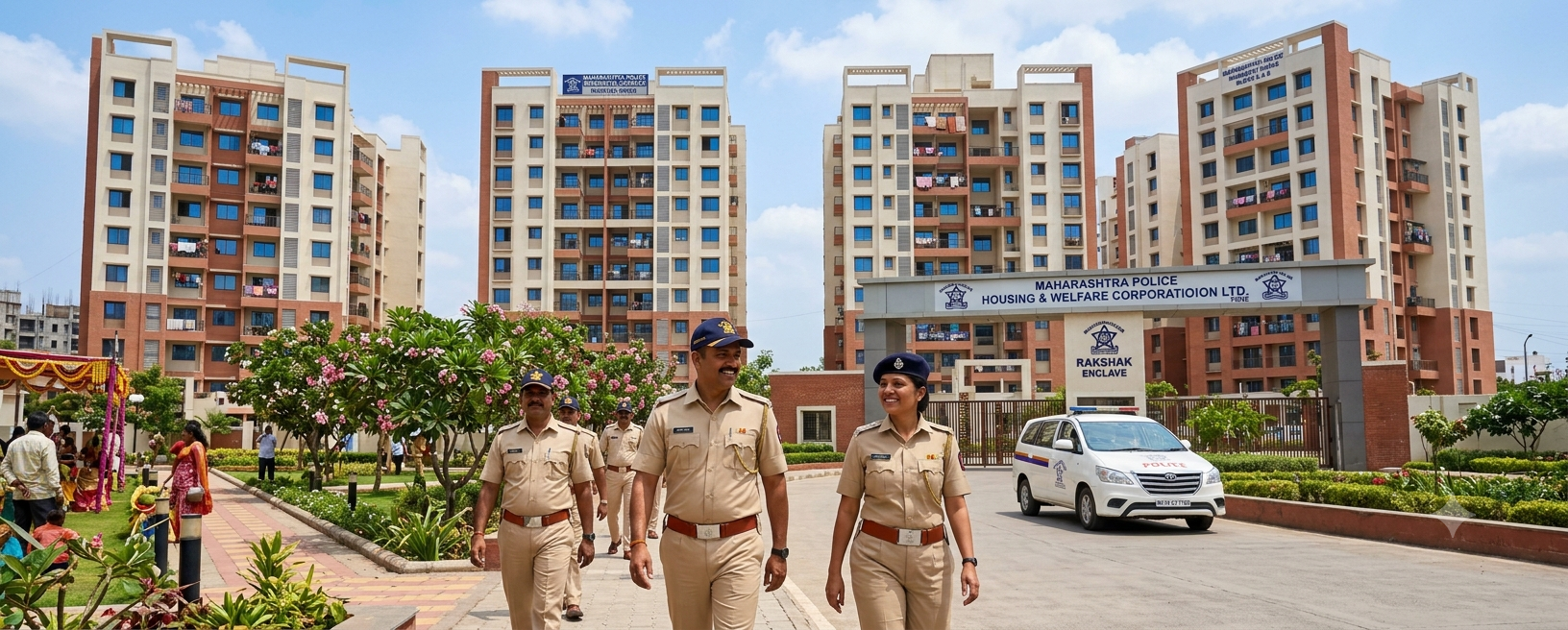

The Maharashtra government has appointed the Maharashtra State Police Housing and Welfare Corporation (MSPHC) as the implementing agency and declared it the developer for police housing projects on lands in the possession of the Police Department across the entire state.
The decision was issued through a Home Department Government Resolution dated 1 September 2026 (No. संडकर्ण-0924/प्र.क्र.260/पोल-7). It extends a framework that was earlier limited to the Brihanmumbai Municipal Corporation (BMC) area.
What the GR decides
Under Regulation 33(3)(A) of the Development Control and Promotion Regulations-2034 (DCPR-2034), MSPHC has been designated as the “implementing agency” and declared the “developer” for police housing projects on police-controlled land throughout Maharashtra.
The corporation has been directed to:
- identify suitable land parcels in the possession of the Police Department; and
- prepare a detailed project report for each such site so that housing projects can be taken up under Regulation 33(3)(A).
The GR is available on the official website www.maharashtra.gov.in (unique code 202609011236510729) and has been digitally signed by Desk Officer Gazala Shankarrao, Home Department, Mantralaya.
Background
A similar Government Resolution of 3 February 2021 (No. संडकर्ण-0121/प्र.क्र.26/पोल-7) had already appointed MSPHC as the implementing agency and developer for such projects within BMC limits.
Public representatives later sought the same arrangement for the rest of the state. Following that demand, the Additional Director General of Police and Joint Managing Director of MSPHC submitted proposals dated 12 December 2023 and 25 January 2024. After government approval of those proposals, the statewide order has now been issued.
Copies of the GR have been marked to the Governor’s Secretary, the Chief Minister’s Principal Secretary, Additional Chief Secretaries of Home and Urban Development, the Director General of Police, the Managing Director of MSPHC, all Additional Directors General, Commissioners of Police, Special Inspectors General and District Superintendents of Police.
What Regulation 33(3)(A) allows
DCPR-2034 Regulation 33(3)(A) permits additional Floor Space Index (FSI) of up to 4, including zonal (basic) FSI, on lands belonging to the government or its statutory bodies for construction of staff quarters. The development can be carried out by nominated public agencies, including the Maharashtra Police Housing Corporation, on plots abutting a road of minimum 12-metre width.
The regulation is meant for staff housing of government and statutory bodies, not for commercial sale to the general public. Premium is payable on built-up area created through additional FSI, subject to rates decided by the government.
By naming MSPHC as both implementing agency and developer, the state has given the corporation a single-window role: identify police land, prepare project reports, and execute the housing schemes under this special FSI provision.
Why the order matters
MSPHC is a government of Maharashtra undertaking set up in 1974 to build residential quarters and administrative buildings for the police, prisons and allied Home Department establishments. It has already delivered thousands of police quarters across the state and is currently executing a large pipeline of residential and office projects.
Police housing shortage remains a live operational issue. In Mumbai alone, earlier government papers have recorded that a large share of the force commutes long distances because service accommodation is inadequate or dilapidated. The state has separately sanctioned housing-advance loan schemes through MSPHC and has been pursuing a Mumbai Police Housing Township Project on multiple police plots.
The 1 September GR does not announce a specific number of units or a list of plots. It creates the legal and administrative platform for MSPHC to use police-department land bank statewide under the staff-quarters FSI route, instead of leaving each district or city to arrange development separately.
Urban local bodies and planning authorities will still have to process individual building proposals under applicable development control rules. The GR itself is an administrative nomination of the agency and developer; it does not amend DCPR-2034.
What happens next
MSPHC must now survey police lands across districts, shortlist sites that meet road-width and planning criteria, and place detailed project reports before government. Only after those reports and subsequent administrative and financial sanctions can construction begin.
For homebuyers and the wider real estate market, the immediate effect is limited: these are staff quarters on government land, not private sale projects. The larger significance is the formal use of a public corporation as developer on a statewide police land bank under a special FSI regulation originally framed for Greater Mumbai.The Maharashtra government has appointed the Maharashtra State Police Housing and Welfare Corporation (MSPHC) as the implementing agency and declared it the developer for police housing projects on lands in the possession of the Police Department across the entire state.
The decision was issued through a Home Department Government Resolution dated 1 September 2026 (No. संडकर्ण-0924/प्र.क्र.260/पोल-7). It extends a framework that was earlier limited to the Brihanmumbai Municipal Corporation (BMC) area.
What the GR decides
Under Regulation 33(3)(A) of the Development Control and Promotion Regulations-2034 (DCPR-2034), MSPHC has been designated as the “implementing agency” and declared the “developer” for police housing projects on police-controlled land throughout Maharashtra.
The corporation has been directed to:
- identify suitable land parcels in the possession of the Police Department; and
- prepare a detailed project report for each such site so that housing projects can be taken up under Regulation 33(3)(A).
The GR is available on the official website www.maharashtra.gov.in (unique code 202609011236510729) and has been digitally signed by Desk Officer Gazala Shankarrao, Home Department, Mantralaya.
Background
A similar Government Resolution of 3 February 2021 (No. संडकर्ण-0121/प्र.क्र.26/पोल-7) had already appointed MSPHC as the implementing agency and developer for such projects within BMC limits.
Public representatives later sought the same arrangement for the rest of the state. Following that demand, the Additional Director General of Police and Joint Managing Director of MSPHC submitted proposals dated 12 December 2023 and 25 January 2024. After government approval of those proposals, the statewide order has now been issued.
Copies of the GR have been marked to the Governor’s Secretary, the Chief Minister’s Principal Secretary, Additional Chief Secretaries of Home and Urban Development, the Director General of Police, the Managing Director of MSPHC, all Additional Directors General, Commissioners of Police, Special Inspectors General and District Superintendents of Police.
What Regulation 33(3)(A) allows
DCPR-2034 Regulation 33(3)(A) permits additional Floor Space Index (FSI) of up to 4, including zonal (basic) FSI, on lands belonging to the government or its statutory bodies for construction of staff quarters. The development can be carried out by nominated public agencies, including the Maharashtra Police Housing Corporation, on plots abutting a road of minimum 12-metre width.
The regulation is meant for staff housing of government and statutory bodies, not for commercial sale to the general public. Premium is payable on built-up area created through additional FSI, subject to rates decided by the government.
By naming MSPHC as both implementing agency and developer, the state has given the corporation a single-window role: identify police land, prepare project reports, and execute the housing schemes under this special FSI provision.
Why the order matters
MSPHC is a government of Maharashtra undertaking set up in 1974 to build residential quarters and administrative buildings for the police, prisons and allied Home Department establishments. It has already delivered thousands of police quarters across the state and is currently executing a large pipeline of residential and office projects.
Police housing shortage remains a live operational issue. In Mumbai alone, earlier government papers have recorded that a large share of the force commutes long distances because service accommodation is inadequate or dilapidated. The state has separately sanctioned housing-advance loan schemes through MSPHC and has been pursuing a Mumbai Police Housing Township Project on multiple police plots.
The 1 September GR does not announce a specific number of units or a list of plots. It creates the legal and administrative platform for MSPHC to use police-department land bank statewide under the staff-quarters FSI route, instead of leaving each district or city to arrange development separately.
Urban local bodies and planning authorities will still have to process individual building proposals under applicable development control rules. The GR itself is an administrative nomination of the agency and developer; it does not amend DCPR-2034.
What happens next
MSPHC must now survey police lands across districts, shortlist sites that meet road-width and planning criteria, and place detailed project reports before government. Only after those reports and subsequent administrative and financial sanctions can construction begin.
For homebuyers and the wider real estate market, the immediate effect is limited: these are staff quarters on government land, not private sale projects. The larger significance is the formal use of a public corporation as developer on a statewide police land bank under a special FSI regulation originally framed for Greater Mumbai.
Also Read: Maharashtra Govt Clears Framework for Large-Scale Mumbai Police Housing Township Project