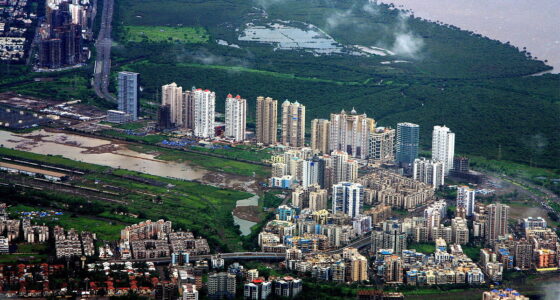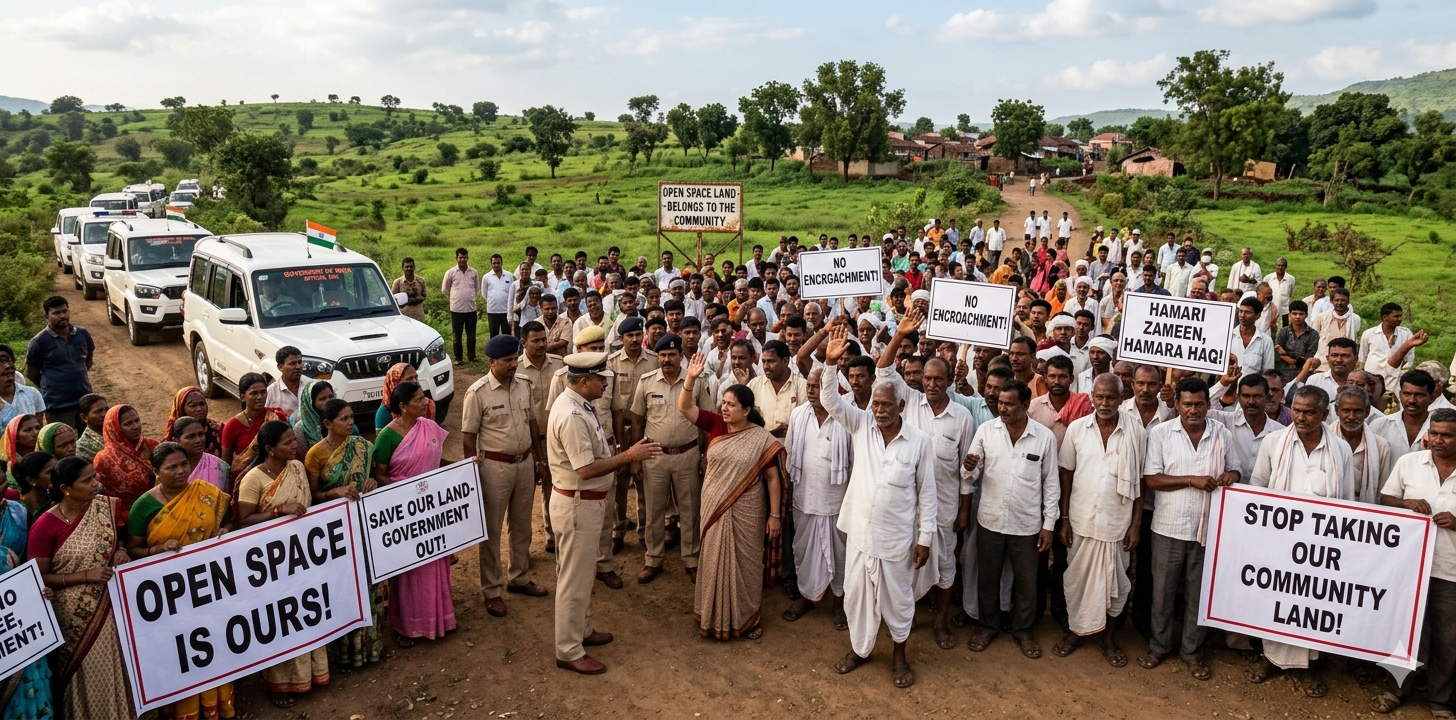
For two decades, Pune’s housing societies and landowners fought a municipal corporation armed with an obscure rule, powerful politicians, and the threat of encroachment. On May 6, 2026, the Bombay High Court called it unconstitutional — and struck it down.
the leafy colony of Erandwane in Pune, the retired soldiers of the Pune Ex-servicemen Co-operative Housing Society had spent years trying to protect a patch of green from encroaching slums and wandering cattle. They hired a nursery, built a jogging path with benches, and fenced it in. Then one February morning in 2010, they opened their newspaper and found something far more alarming than slum-dwellers at the gate — it was the Pune Municipal Corporation itself, announcing it was taking their open space. For compensation of exactly one rupee.
That rupee became the symbol of a long and bitter battle. Across Pune, from Walvekar Nagar to Aundh to Parvati, other landowners and plot holders read similar declarations in local newspapers over a span of years stretching back to 2004. A brief public notice. A month to raise objections. And then, possession. Their common spaces — parks, gardens, jogging tracks that they had built and maintained — were being claimed by a civic body invoking Rule 13.3.1.5 of Pune’s Development Control Rules. Five different sets of petitioners, five different layouts, one terrifying rule.
On May 6, 2026, a division bench of the Bombay High Court, comprising Justices Manish Pitale and Shreeram V. Shirsat, put an end to it. Rule 13.3.1.5 was declared unconstitutional. It was struck down.
The Rule That Took Land for a Rupee
Rule 13.3.1.5 of Pune’s Development Control Rules — brought into force on February 5, 1987 — reads, at its core, like a bureaucratic formality. Whenever called upon by the Planning Authority, open spaces in layouts “shall be handed over to the Planning Authority after development of the same for which nominal amount (of ₹1) shall be paid.” It then adds a second limb: if the authority is “convinced that there is misuse of open spaces,” it “shall take over the land.”
No definition of misuse. No notice required before the declaration. No reference to the Land Acquisition Act or to the provisions of the Bombay Provincial Municipal Corporations Act that actually govern acquisition of property. The rule cited only Sections 202 and 203 of the BPMC Act — provisions, the petitioners would argue, that deal exclusively with the vesting of public streets in the corporation, and have nothing whatsoever to do with open spaces.
The Rule in Question — Rule 13.3.1.5
“Whenever called upon by the Planning Authority to do so, under provisions of Section 202, 203 of BPMC Act, areas under roads and open space… shall be handed over to the Planning Authority after development of the same for which nominal amount (of ₹1) shall be paid… in which case the Authority shall take over the land.”
On paper, the PMC positioned this not as acquisition but as management — an exercise of “police powers” for public good. The open spaces are the lungs of the city, the corporation’s lawyers argued. They cannot be permitted to be misused. But what exactly constituted misuse was never written down. And that, the petitioners would argue for two decades, was precisely the problem.
Five Battles, Five Stories
The fights did not begin simultaneously. They accumulated, one newspaper notice at a time, across a decade.
- 1954–73 Layouts sanctioned: All five layouts — in Erandwane, Walvekar Nagar, Parvati, Aundh, and Survey Nos. 89/2–91/2 — were approved by the PMC years before the DC Rules came into force in 1987. Open spaces had been earmarked by the original planners.
- 1987 DC Rules notified: The Development Control Rules, including Rule 13.3.1.5, came into effect on February 5, 1987 — years, sometimes decades, after all five layouts had already been sanctioned.
- 2004 First declaration — Walvekar Nagar: The PMC published a notice declaring intent to take possession of open spaces in the layout developed by the Walvekar family. Petitioners alleged they found a local politician personally supervising the PMC’s move to take possession.
- 2005 Parvati owners file suit: The Gadve family’s layout at Parvati had an active application pending before the PMC for a recreation centre. While awaiting response, the PMC published its takeover notice. Civil suits and a writ petition followed.
- 2006 Aundh declaration: The petitioner in Writ Petition 4433 had planted trees in his layout’s open space. A PMC declaration followed, citing misuse, offering ₹1 compensation.
- 2008–09 The acquisition that wasn’t: In the fifth case, the PMC’s own City Engineer and Special Land Acquisition Officer had initiated formal acquisition proceedings under the Land Acquisition Act. Then, abruptly, in October 2009, the newspaper declaration appeared instead — at the insistence, petitioners alleged, of a local corporator.
- 2010 Ex-servicemen’s society challenged: Pune Ex-servicemen Co-operative Housing Society, having developed a jogging park with a nursery, received the final notice. Writ Petition 5838 of 2010 was filed. All five petitions were tagged together.
- 2026JudgmentArguments concluded on March 25. The division bench pronounced its judgment on May 6, 2026.
The Fear Behind the Fence
For the ex-servicemen’s society in Erandwane, the trouble had begun not with the PMC but with human geography. The open space designated ‘C’ in their layout abutted a slum. Residents of that settlement had been making attempts to encroach, cattle wandered in, and the open ground was slowly being swallowed. The society had done what responsible residents do: they hired Surabhi Nursery, built a jogging track, placed benches. They created a functioning, maintained green space that their members used every day.
Then came the complaint — someone told the PMC the space was being “misused.” And the PMC agreed, apparently without ever visiting or issuing a notice to the society. The February 2010 declaration in Daily Sakal was their first indication that the corporation was walking in, with one rupee in hand.
“The open spaces are lungs of the city and cannot be permitted to be wasted or misused.”— PMC’s argument before the High Court
In Walvekar Nagar, the battle had a rawer, more political edge. The Walvekar family, owners of open spaces in a 1971-sanctioned layout, sent a legal notice to the PMC after its October 2004 declaration. The next day, they read in the Indian Express that the corporation had already taken possession. When they rushed to the site, they allegedly found a local politician and an influential corporator personally directing PMC officers to take over. The petitioners had to run to the High Court to get even a status quo order.
In the fifth case — Survey Nos. 89/2, 90/2 and 91/2 — the situation was perhaps the most damning. The PMC’s own engineers had concluded that formal acquisition was the appropriate route. A letter dated December 31, 2008, from the City Engineer formally initiated acquisition proceedings. By July 2009, the Special Land Acquisition Officer was processing joint measurement maps. The process was well underway. And then a corporator, according to the petitioners, pushed for the Rule 13.3.1.5 route instead — faster, cheaper, and accompanied by just one rupee.
The Corporations’ Case: Public Good, Not Acquisition
R.M. Pethe, counsel for the PMC, and the Additional Government Pleader appearing for the State, mounted a defence built on two pillars. First, they argued, the right to property is no longer a fundamental right — it is a constitutional right under Article 300A, a less robust protection. Under 300A, a person can be deprived of property “by authority of law,” and the DC Rule, they argued, was exactly that authority.
PMC & State’s Argument
The DC Rule is valid law. The takeover is not acquisition but management of open spaces in exercise of police powers. Property rights under Article 300A are satisfied by any lawful authority. The 2024 Supreme Court judgment in Association of Vasanth Apartments covers this situation.
Petitioners’ Argument
The Rule cites wrong provisions of the BPMC Act. ₹1 is illusory, not compensation. There is no definition of “misuse,” giving the PMC unbridled power. Article 300A still demands just, fair and reasonable treatment. The Supreme Court’s earlier judgments squarely cover and condemn this situation.
Their second pillar was the 2024 Supreme Court ruling in Association of Vasanth Apartments’ Owners v. V. Gopinath, which had upheld a Development Control Rule requiring developers to transfer 10% of project area to planning authorities through a gift deed, without compensation. That, the PMC argued, was its trump card: the Supreme Court had itself blessed such transfers.
The State went further, arguing that the condition of maintaining open spaces was “voluntarily accepted” by developers in exchange for FSI benefits. Since the FSI of the open spaces had already been consumed in the rest of the layout, no separate compensation was due. Token payment of ₹1 was, they said, not only legally sufficient but conceptually appropriate.
The Court’s Verdict: Three Strikes
The High Court was unimpressed. Its reasoning dismantled the defence on three distinct grounds, each independently fatal to Rule 13.3.1.5.
First: The wrong source of power. Sections 202 and 203 of the BPMC Act — the rule’s stated legal foundation — pertain exclusively to the vesting and maintenance of public streets. They appear in Chapter XIV of the Act, which deals only with streets. Open spaces are nowhere mentioned. The Court found that the rule was therefore ultra vires the Act itself; it had bootstrapped a power to acquire open spaces onto provisions that grant no such power. Chapter VIII of the BPMC Act, which specifically deals with acquisition of property, was never invoked.
Court’s Finding — Ultra Vires
“A bare perusal of the above-quoted provisions of the BPMC Act, which are purported source for framing the said Rule, shows that the said provisions have nothing to do with open spaces in sanctioned layouts… There is absolutely no reference to common spaces. Thus, the said Rule is ultra vires the BPMC Act itself.”
Second: Illusory compensation violates Article 300A. The Court drew on a Constitution Bench judgment of the Supreme Court in K.T. Plantation Pvt. Ltd. v. State of Karnataka (2011), which had made clear that even under Article 300A, a law depriving a person of property must be just, fair and reasonable. It cannot offer “no compensation” — and while “nil” compensation may be justified in narrow circumstances, the burden lies on the State to demonstrate it. A flat statutory declaration that ₹1 is sufficient, with no reasoning and no process, does not discharge that burden. The Court reaffirmed that the right to property, even as a constitutional right, is a human right that “cannot be casually trampled upon.”
Third: Unbridled, arbitrary power violates Article 14. The term “misuse” appears in the Rule with no definition, no criteria, no procedural safeguard. There was no obligation to issue a prior show cause notice, no requirement to hear the affected parties before a declaration was published, no threshold a civic body had to cross before invoking the Rule. The Court found this a manifest violation of Article 14’s guarantee of non-arbitrariness. It noted pointedly that Rule 13.3.1.3 of the same DC Rules actually permits construction of structures — pavilions, gymnasia — within open spaces, indicating that not all development constitutes misuse. Yet the Rule gave the PMC carte blanche to override even lawful use.
Distinguishing the Vasanth Apartments Judgment
The Court’s handling of the PMC’s trump card — the 2024 Supreme Court ruling in Vasanth Apartments — was surgical. In that case, the Supreme Court had upheld a Development Control Rule requiring transfer of 10% open space through a gift deed. But the Court noted key factual distinctions: that rule had been framed under specific statutory provisions in the parent Act that dealt with development plans and reservations; the transfer was embedded in a comprehensive statutory scheme from the outset; and the developer had executed a voluntary gift deed as part of an explicit condition of development approval.
Here, by contrast, the layouts predated the DC Rules by decades. The rule invoked provisions about streets. And there was nothing voluntary about residents being confronted with a newspaper announcement offering one rupee. The High Court concluded that the Vasanth Apartments judgment not only did not cover the present situation — it actually reinforced why the earlier precedents in Yogendra Pal and Pt. Chet Ram Vashist applied.
“The message must be loud and clear — the rule of law exists in this country even when we interpret a statute which has the blessings of Article 300A.”— Supreme Court, K.T. Plantation v. State of Karnataka (quoted in judgment)
Standing on the Shoulders of Earlier Fights
This was not a battle fought in isolation. The petitioners’ counsel — led by Senior Advocate G.S. Godbole, with Mr. S.S. Kanetkar and Mr. Drupad Patil appearing for the other petitioners — pointed to a consistent thread of judgments from both the Supreme Court and this High Court condemning exactly this kind of rule.
In 1994, the Supreme Court in Yogendra Pal v. Municipality, Bhatinda had demolished the argument that “transferred” was different from “acquired” — holding that using the word transfer was a “euphemism for acquisition,” and that the loss of ownership rights without fair compensation could not be dressed up in different language. In 1995, in Pt. Chet Ram Vashist v. Municipal Corporation of Delhi, the Court had held that a municipal corporation’s right to manage an open space does not extend to claiming its ownership.
Closer to home, this Court had in 2003 in Vrajlal Jinabhai Patel v. State of Maharashtra struck down an identically worded bye-law applicable to municipal councils, on precisely the same grounds. That judgment was followed in 2009, and again in December 2025, when a writ petition challenging a similar rule applicable to Baramati Nagar Parishad was allowed. The Pune petitioners were carrying forward a lineage of civic resistance that had been building for three decades.
What the Judgment Means
The High Court’s order is comprehensive. Rule 13.3.1.5 is declared unconstitutional and struck down. The newspaper declarations issued by the PMC against all five petitioners are quashed. All consequential actions taken in pursuance of those declarations are directed to be “rectified to restore the status as existed prior” to the declarations. The petitioners, the Court held, “are entitled to use the open spaces in accordance with law.”
What the judgment does not do is leave open spaces unprotected. The Court made clear that the PMC retains its general municipal powers to issue notices and take action if structures are erected in violation of the DC Rules. Legitimate misuse can be addressed — but through proper legal processes, with fair notice, proper procedure, and compensation that reflects the real value of the land, not a rupee slipped under the door.
For the ex-servicemen in Erandwane, the Walvekar family, the residents of Parvati, Aundh, and the fifth layout whose internal PMC documents had already called for proper acquisition — the order is a restoration. Their open spaces remain theirs. Their jogging tracks, their planted trees, their fenced gardens — built against the threat of encroachment from one direction and the overreach of the state from another — stand.
The one rupee was never payment. It was always an insult. The High Court has finally said so, in writing.
Also Read: Maharashtra Winds Down Smart City SPVs, Hands Charge to Municipal Commissioners