
The Maharashtra government has approved the distribution of ₹240 crore collected through the 1% stamp duty surcharge to 28 municipal corporations for the financial year 2026-27, with substantial deductions being made towards Energy Efficiency Services Limited (EESL) dues and interest payable under the Urban Infrastructure Development Fund (UIDF) scheme.
The Government Resolution (GR) issued by the Urban Development Department on September 29, 2026, provides for the release of ₹240 crore under the stamp duty surcharge head.
However, the amount that will actually be distributed as net stamp duty grant to municipal corporations is ₹214.91 crore after deductions of ₹23.53 crore towards EESL dues and ₹1.56 crore towards UIDF-related interest.
The order is linked to the 1% surcharge imposed on stamp duty in respect of certain transactions involving immovable property in municipal corporation areas.
KEY NUMBERS
₹240 crore — Total sanctioned allocation for 2026-27
₹23.53 crore — EESL-related deduction
₹1.56 crore — UIDF interest deduction
₹214.91 crore — Net amount to be distributed after deductions
28 — Municipal corporations covered by the distribution
₹75.12 crore — Largest net allocation, to Pune Municipal Corporation
Why Is This 1% Stamp Duty Surcharge Being Distributed?
The Maharashtra Municipal Corporations Act was amended to provide for an additional 1% surcharge on stamp duty in relation to specified instruments concerning immovable property situated within cities.
The surcharge applies to instruments relating to sale or gift of immovable property based on the value of the property, and to usufructuary mortgages based on the amount secured through the instrument.
The revenue generated through this surcharge is intended to be provided to municipal corporations.
For 2026-27, the Urban Development Department has now sanctioned ₹240 crore for distribution under this mechanism.
But ₹240 Crore Is Not the Net Civic Allocation
One of the most important aspects of the GR is the distinction between the sanctioned amount and the amount that municipal corporations will actually receive after adjustments.
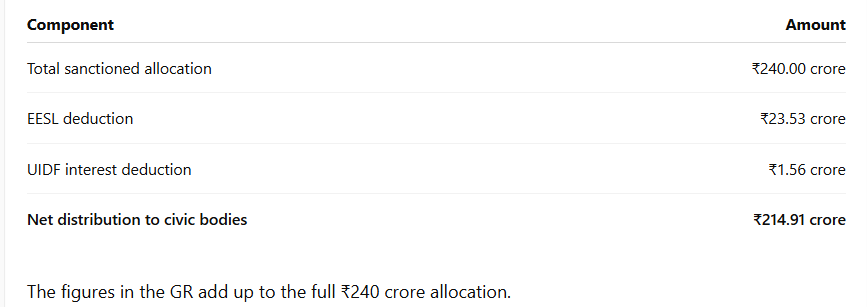
The government has sanctioned a total of:
₹240,00,00,000
From this:
- ₹23,53,15,441 is earmarked for payment of outstanding EESL dues relating to LED street-lighting work.
- ₹1,56,28,939 is deducted towards interest payable under the UIDF scheme.
- ₹214,90,55,620 remains for distribution to the concerned municipal corporations as the net stamp duty grant.
The ₹240-crore calculation
EESL Dues Account for ₹23.53 Crore
A substantial portion of the allocation is being adjusted against pending payments to EESL.
The Urban Development Department states that information regarding amounts payable up to November 2025 for LED street-lighting work undertaken by EESL was received in respect of 14 municipal corporations.
The government has accordingly directed that ₹23.53 crore be transferred to the Commissioner-cum-Directorate of Municipal Administration for payment to EESL.
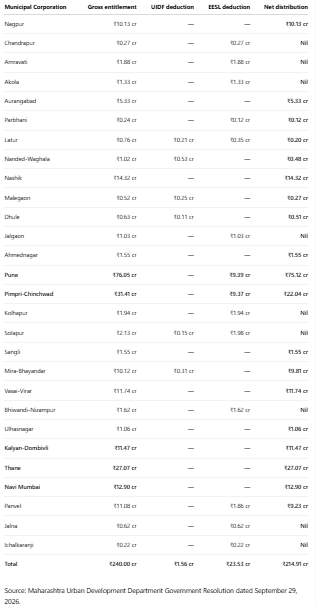
The EESL-related deductions are reflected corporation-wise in the government order.
This means the stamp duty surcharge allocation is not simply a fresh cash transfer to every municipal corporation. In several cases, the government is using part of the amount otherwise payable to the civic body to settle outstanding obligations.
WHAT THIS MEANS
The ₹240 crore is the sanctioned gross allocation.
₹214.91 crore is the net amount approved for distribution after the specified deductions.
Another ₹1.56 Crore Goes Towards UIDF Interest
The second adjustment relates to the Urban Infrastructure Development Fund, or UIDF.
The government states that municipal corporations that have received loans from the National Housing Bank under UIDF were required to pay interest for the April-June 2026 period.
For the municipal corporations listed in the GR, ₹1,56,28,939 is being deducted from their stamp duty grant towards this interest liability.
The amount is to be credited under the specified government receipt head.
This creates another important feature of the distribution: the stamp duty grant is also being used as a mechanism for adjusting certain outstanding municipal obligations to the government.
Pune Gets the Largest Net Allocation
Pune Municipal Corporation emerges as the largest beneficiary under the 2026-27 distribution.
Pune’s gross entitlement is approximately ₹76.05 crore.
After an EESL deduction of approximately ₹93.92 lakh, the corporation is approved to receive a net ₹75.12 crore.
The size of Pune’s allocation is substantially higher than that of the other municipal corporations listed in the order.
Thane is the second-largest recipient, with a net allocation of approximately ₹27.07 crore, while Pimpri-Chinchwad is approved for approximately ₹22.04 crore after an EESL deduction of about ₹9.37 crore.
Corporation-wise Distribution
Six Municipal Corporations Receive No Net Amount
The corporation-wise table also throws up an important point: several municipal corporations have their entire gross entitlement absorbed by deductions.
Based on the figures in the GR, Chandrapur, Amravati, Akola, Jalgaon, Kolhapur, Solapur, Bhiwandi-Nizampur, Jalna and Ichalkaranji have no net amount shown for distribution after the specified deductions.
In some cases, the entire allocation is deducted towards EESL dues.
In Solapur’s case, for example, the gross entitlement is approximately ₹2.13 crore, while ₹1.49 lakh is deducted towards UIDF interest and approximately ₹1.98 crore towards EESL, leaving no net distribution.
The same principle applies to several other corporations where the EESL deduction is equal to, or effectively consumes, the gross entitlement.
This is an important distinction from simply saying that all 28 corporations are receiving fresh funds.
Mumbai Region Gets a Significant Share
The distribution also has a significant concentration among municipal corporations in the Mumbai Metropolitan Region.
The major MMR allocations include:
- Thane: ₹27.07 crore
- Pimpri-Chinchwad: ₹22.04 crore
- Navi Mumbai: ₹12.90 crore
- Kalyan-Dombivli: ₹11.47 crore
- Vasai-Virar: ₹11.74 crore
- Panvel: ₹9.23 crore
- Mira-Bhayandar: ₹9.81 crore
The order therefore directs a substantial amount of the net distribution towards some of the largest urban local bodies in and around the Mumbai region.
Pune Alone Accounts for More Than One-Third of Net Distribution
Pune’s net allocation of approximately ₹75.12 crore represents roughly 35% of the ₹214.91 crore net amount available after deductions.
That makes Pune’s allocation considerably larger than the other individual municipal corporations.
The next largest net allocations are:
- Pune — approximately ₹75.12 crore
- Thane — approximately ₹27.07 crore
- Pimpri-Chinchwad — approximately ₹22.04 crore
- Navi Mumbai — approximately ₹12.90 crore
- Vasai-Virar — approximately ₹11.74 crore
- Kalyan-Dombivli — approximately ₹11.47 crore
- Nagpur — approximately ₹10.13 crore
- Mira-Bhayandar — approximately ₹9.81 crore
- Panvel — approximately ₹9.23 crore
- Nashik — approximately ₹14.32 crore
The ordering above is based on the net amounts stated in the GR; the government order itself does not provide a ranking.
Why the Stamp Duty Surcharge Matters to Cities
Stamp duty is directly linked to transactions involving immovable property. Consequently, the revenue generated through the surcharge provides a mechanism for transferring a portion of property-transaction-related revenue towards urban local bodies.
The present GR is therefore significant not merely because ₹240 crore has been sanctioned, but because it demonstrates how the government is allocating the proceeds of the 1% surcharge while simultaneously adjusting specific municipal liabilities.
The order also makes clear that the distribution is unconditional in nature, subject to the government instructions and accounting adjustments specified in the GR.
The Bigger Picture: Gross Allocation Versus Actual Cash Flow
The most important way to read this GR is through three different numbers:
₹240 crore — sanctioned allocation
This is the total amount approved under the 2026-27 budgetary provision for the 1% stamp duty surcharge.
₹25.09 crore — combined deductions
This consists of:
- ₹23.53 crore towards EESL dues
- ₹1.56 crore towards UIDF interest
₹214.91 crore — net distribution
This is the amount remaining for distribution after the specified deductions.
THE REAL TAKEAWAY
₹240 crore sanctioned ≠ ₹240 crore reaching municipal corporations as unrestricted net distribution.
The GR provides for ₹214.91 crore to be distributed after adjustments, while ₹25.09 crore is directed towards EESL and UIDF-related liabilities.
What This Means for Municipal Corporations
For municipal corporations receiving substantial net allocations, the funds provide an additional revenue stream tied to the state’s 1% stamp duty surcharge mechanism.
However, the corporation-wise table shows that the benefit is not uniform.
Some corporations receive substantial net amounts, while others have their entire gross entitlement adjusted against specified liabilities.
This means the headline ₹240 crore figure needs to be read alongside the corporation-wise deductions before assessing the actual financial benefit to each civic body.
Government Sets Out Direct Disbursement Mechanism
The GR directs the Drawing and Disbursing Officer to draw the sanctioned ₹240 crore from the relevant government account and distribute the amounts according to the approved allocation.
The order identifies the relevant controlling and drawing authorities for implementing the distribution.
The expenditure is to be booked under the specified budget head:
3604 — Local Bodies and Panchayati Raj Institutions — Stamp Duty-related compensation/assigned amounts, including the 1% surcharge intended for municipal corporations.
The GR also states that any dues payable to government and semi-government institutions may be recovered or adjusted from the sanctioned grant before distribution.
Bottom Line
Maharashtra has approved ₹240 crore for distribution to 28 municipal corporations from the 1% stamp duty surcharge for 2026-27.
But the actual distribution picture is more nuanced.
₹23.53 crore will be adjusted towards EESL dues and ₹1.56 crore towards UIDF interest, leaving ₹214.91 crore for net distribution.
Pune is the largest beneficiary, with a net allocation of approximately ₹75.12 crore, followed by Thane at ₹27.07 crore and Pimpri-Chinchwad at ₹22.04 crore.
At the other end, several municipal corporations see their entire gross entitlement absorbed through the specified deductions.
The GR therefore represents both a transfer of stamp-duty-linked revenue to urban local bodies and an accounting mechanism through which certain outstanding municipal obligations are settled before the remaining funds reach the civic bodies.
For municipal corporations, the critical number is consequently not simply the ₹240-crore headline allocation, but the ₹214.91 crore net amount and the corporation-wise figure after deductions.
Also Read: ₹1,500 Crore Disbursed from Stamp Duty Surcharges to MMRDA, & Metro Projects