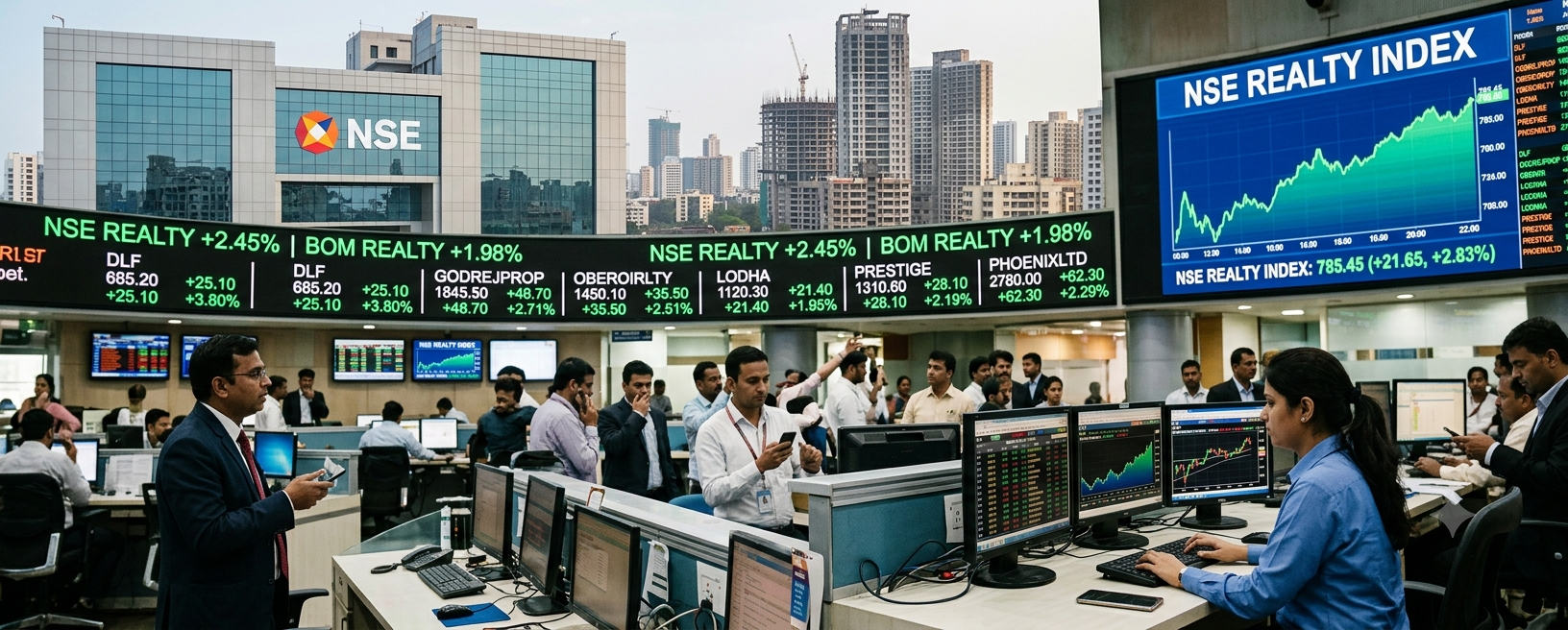

Friday August 21 opens with a market that has stopped falling but has not yet started surging. The Sensex at 77,587 is up just 49 points or 0.06%. The Nifty50 at 24,249 is 17 points higher — a number that barely registers as movement. Oil prices have extended their gains for a sixth consecutive session on simmering US-Iran tension, keeping the sector’s most persistent headwind alive into the final trading day of the week. IT stocks and oil and gas shares are weighing on the Nifty at this morning’s open. And the Hormuz joint statement — the one development that can break the market out of its 23,600–24,700 sideways range in a single session — has still not been formally published. For the Nifty Realty index, Friday is a session of holding rather than advancing. The week ends where it began — with the sector’s recovery thesis intact, its fundamental anchors strong, and one deal announcement standing between where it is and where it needs to go.
The Peg: Six Straight Sessions of Oil Gains. One Joint Statement Away From Reversal.
The defining characteristic of this week’s market has been oil’s resilience. Brent crude has gained for six consecutive sessions on simmering US-Iran tension — a streak that has kept the sector’s input cost story under pressure even as diplomatic signals from Muscat have been consistently positive. The Iran-Oman Hormuz deal framework is agreed. Coordinates are confirmed. Routes are defined. A joint statement is being drafted. And yet the oil market has continued climbing because “being drafted” is not the same as “being published” — and the IRGC’s parallel-track position on Strait management continues to cast a shadow on implementation certainty.
For the Nifty Realty index, which has been the Indian market’s most consistent expression of the crude oil-Iran peace thesis throughout CY26, this six-session oil rally has translated into continued sector underperformance even as the broader market found its footing. Thursday’s 0.64% Nifty advance — led by Nifty Media rising 2.13% — did not include a meaningful realty sector contribution. The sector is holding its range at approximately 875–890 rather than extending the recovery toward 950 and beyond.
The chart structure, as confirmed by technical analysts in today’s Business Standard market live update, is “sideways as long as the index continues to consolidate within the 23,600–24,700 spot range on a closing basis.” That description perfectly captures where the realty sector sits this Friday morning — in a holding pattern that requires a catalyst to break, and that catalyst is the Hormuz joint statement that the US had been aiming to announce before the end of this week.
How Realty Stocks Are Opening
The Nifty50 bounced back from the key gap-support zone around 24,000 on Thursday — filling the gap left during the July 29 rally and then recovering — which provides a technically constructive foundation for Friday’s session. Resistance at 24,400–24,450 is the next level the index must clear to signal a genuine upside break from the current sideways range.
The Nifty Realty index opens Friday at approximately 880–890, holding its weekly range with measured stability. The sector’s Friday tone is one of cautious consolidation — buyers present but not aggressive, sellers not pressing, volume thin ahead of the weekend. This is the most typical pattern for the sector on a Friday when the primary catalyst is a geopolitical development expected over the weekend or the following week.
DLF, the index’s largest constituent at a 19.96% weight, opens Friday in a narrow range around ₹645–655. The stock’s catch-up trade — which had generated the week’s most discussed institutional positioning story after the 2.65% August 10 gain and 1.43% August 13 advance — has been partially reversed by this week’s oil rally. At ₹645–655, DLF’s discount to analyst targets of ₹775 has actually widened slightly from where it stood at the week’s open — a function of the oil headwind rather than any company-specific deterioration.
Godrej Properties at approximately ₹2,020–2,040 opens Friday with a measured tone. The MoHUA force majeure RERA extension announced on August 12 — which directly protects Godrej Properties’ Maharashtra project portfolio from RERA default proceedings — is the domestic positive that has provided a floor to the stock this week even as oil’s six-session rally has capped its upside. Lodha Developers, whose ₹5,620 crore record Q1 FY27 presales continue to anchor institutional conviction, opens Friday as the sector’s most resilient name. Prestige Estates Projects, Sobha, Phoenix Mills, Brigade Enterprises, Anant Raj, Aditya Birla Real Estate, and Oberoi Realty all open Friday with a flat to marginally positive bias.
The broader market’s sectoral landscape on Friday morning — IT and oil and gas weighing, no clear sectoral leadership — reflects a market in transition mode between the sideways consolidation of the past week and whatever the Hormuz joint statement catalyses in the sessions ahead. Realty’s flat open is consistent with that transition mood.
What Is Working
The rupee opening 7 paise stronger at 95.64 against the dollar — compared to Thursday’s close of 95.71 — is a modest but directionally positive signal on Friday morning. A rupee that is strengthening slightly even as oil extends its six-session gain suggests that currency markets are beginning to price in the Hormuz deal’s imminence. Currency markets are the fastest-moving of all financial markets — even a 7-paise move toward rupee strength in the face of rising oil is the currency market saying it believes the oil rally is near its end.
The Nifty’s recovery from the 24,000 gap-support zone on Thursday — confirmed by Business Standard’s technical analysis — is the most important chart-level positive heading into Friday. The index has held its technical support despite six sessions of oil gains, a still-unpublished Hormuz joint statement, FII selling, and a Sensex that remains below 78,000. A market that holds technical support through adverse conditions is a market that is positioned to advance strongly when conditions improve.
The MoHUA force majeure RERA extension — which formally protects all listed developers with projects registered under RERA 2016 from being declared “in default” for war-related delays — continues to be the domestic regulatory anchor that insulates the sector from a potential Q3 FY27 default wave. Business Standard has confirmed that this extension may save stalled housing projects from insolvency risk — a material positive for homebuyer confidence in under-construction properties and for the listed developer universe’s regulatory standing.
The sector’s dividend declaration wave remains the financial health signal that institutional investors are incorporating into their medium-term positioning. Five of ten Nifty Realty constituents having declared final dividends in the past month — DLF at ₹8 per share, Godrej Properties at ₹10 per share, Lodha at ₹4.25 per share, Brigade at ₹2 per share, and Prestige at ₹2 per share — collectively signal that the sector’s strongest names generated sufficient cash flow through the Iran conflict period to return capital to shareholders. That is the balance sheet confidence signal that keeps institutional buyers present on every dip.
What Isn’t Working
Oil extending gains for a sixth consecutive session on simmering US-Iran tension is the week’s most persistent and damaging headwind for the sector. The six-session streak — during which Brent has climbed from approximately $86 to above $90 — has reversed a significant portion of the input cost relief that had been rebuilding since the Muscat first round. For developers with large under-construction portfolios, every session that oil holds above $88–90 adds incremental pressure to construction logistics costs, cement transportation costs, and steel delivery expenses that are directly reflected in project completion economics.
The Hormuz joint statement not having been published by Friday morning — despite the US aiming for a Wednesday August 19 announcement — means the week will end without the catalyst that could have broken the market decisively out of its 23,600–24,700 sideways range. The delay is now four days from the original target date. While the framework is reportedly agreed and coordinates confirmed, the IRGC’s parallel-track position on Strait management remains the last-mile complication that is holding up the formal publication. The longer this delay extends, the more risk there is that geopolitical noise over the weekend creates a fresh negative catalyst rather than a positive one.
IT stocks and oil and gas shares weighing on Friday’s market open means the two sectors that most directly signal Indian corporate earnings health — IT for services demand, oil and gas for energy cost management — are both negative at the start of the week’s final session. That dual sectoral drag limits the broader market’s ability to provide the rising tide that realty stocks need to advance on days when no specific sector-level catalyst is present.
FII selling pressure persisting through the week has kept the Nifty from building the sustained positive momentum that would normally follow a week where the market held key technical support, domestic dividends were paid, and a major diplomatic deal was being finalised. The structural FII selling pattern — a function of global portfolio managers reducing India exposure while Iran risk premium remains unresolved — will only decisively reverse when the Hormuz joint statement is published and crude falls meaningfully below $85.
What to Watch Through the Day
The Hormuz joint statement remains Friday’s most critical potential development. Four days after the US aimed for a Wednesday announcement, the publication could come at any moment — through Iran’s Foreign Ministry Telegram channel, Oman’s Foreign Ministry website, or a formal US State Department press briefing. Any formal confirmation during Indian market hours — even a preliminary statement of principles — would push crude down 5–7% and trigger an immediate 3–5% surge in the Nifty Realty index.
Crude oil’s intraday behaviour is the real-time proxy for diplomatic progress. Brent falling below $88 through Friday’s session would signal the market is pricing in an imminent announcement. Any move above $92 would signal fresh escalation risk that could make the weekend a difficult one for Monday’s open.
The Nifty50’s resistance zone at 24,400–24,450 — identified by technical analysts in today’s Business Standard update — is the level to watch for an upside break. A confirmed Hormuz deal announcement during Friday’s session could push the Nifty through that resistance in a single move, clearing the path toward 24,700 and ultimately toward the August 28 expiry’s maximum call OI target of 25,000.
The rupee’s trajectory through Friday’s session will be the most sensitive real-time barometer of what the market believes is happening in Tehran and Muscat. A rupee strengthening through 95.50 during the session — despite oil’s continued rally — would signal that currency market participants have received a credible signal that the Hormuz announcement is imminent. A rupee weakening back toward 96 would signal the opposite.
Within the sector, watch Lodha Developers and DLF for any unusual buying volume through the session. Both stocks have been the primary targets of institutional accumulation through the current recovery cycle — and any sharp intraday volume spike in either name without a corresponding price move would signal institutional buyers positioning ahead of an expected weekend announcement.
Friday August 21 closes a week that delivered more patience than progress for the Nifty Realty index. The MoHUA force majeure RERA extension provided the domestic regulatory floor. The Muscat second round confirmed the diplomatic framework. But oil’s six-session rally and the Hormuz joint statement’s delayed publication kept the sector in its 23,600–24,700 sideways consolidation range. The catalyst that breaks that range is ready. The joint statement is drafted. The coordinates are agreed. The announcement is the only remaining step. Whether it comes over the weekend or early next week, the week of August 24 will be the one that tests whether the Nifty Realty index’s recovery toward 1,009 and beyond was delayed by days — or by something more consequential.
Also Read: Realty Stocks Attempt Recovery as US Drops Hormuz Fee; Crude at $84 Caps Gains