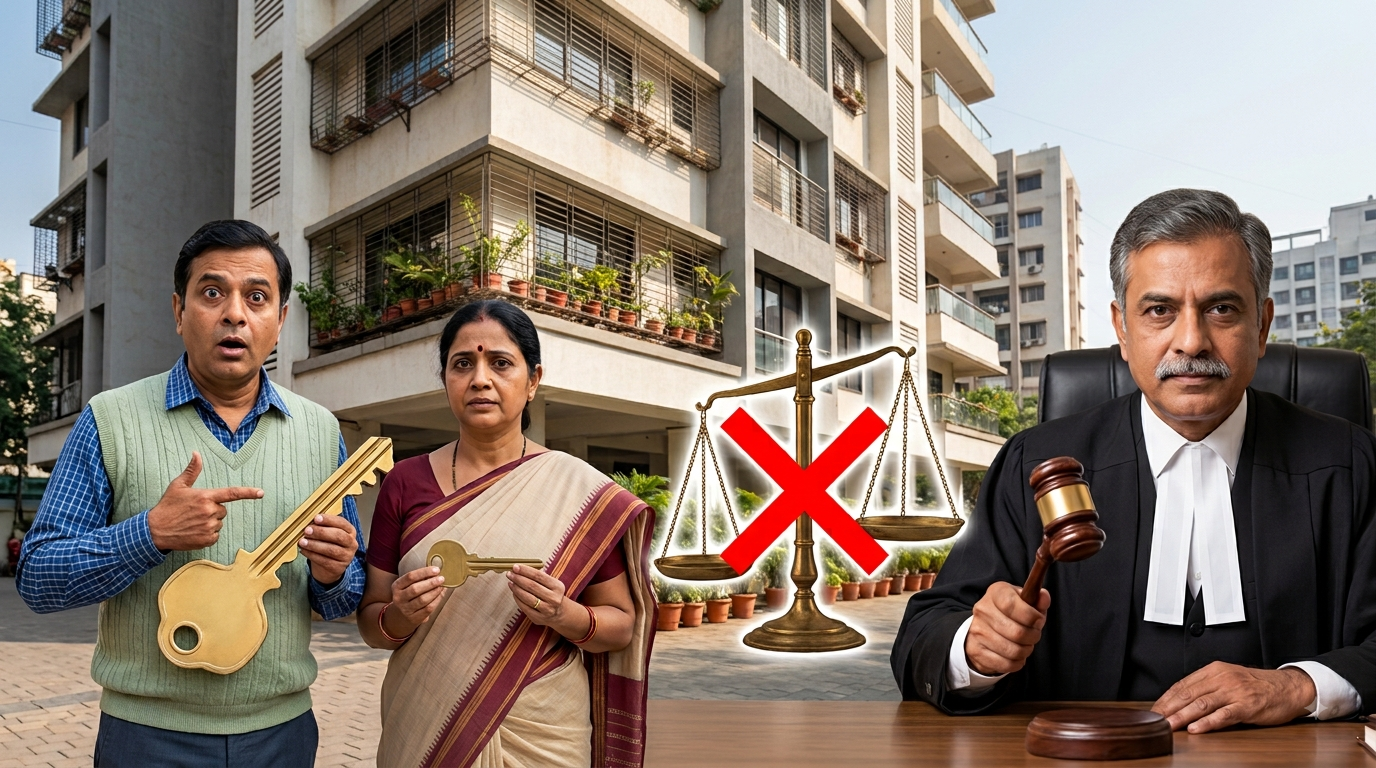

A long-pending dispute decided by the Co-operative Court No. 3, Mumbai on 10 August 2026 has once again underlined a clear legal position that housing societies often ignore: common maintenance and service charges must be equal for all members. A society cannot charge more merely because a flat or shop has a larger area or is commercial in nature.
In Dispute No. CC/III/161/2007 (Worli Himalaya Co-operative Housing Society Ltd.), shop owners had challenged higher maintenance bills raised by the society. After nearly 19 years, the Court partly allowed the dispute and held that differential common maintenance charges based only on area or commercial character are not permissible.
The Court relied on two important Bombay High Court judgments — Venus Co-operative Housing Society Ltd. v. Dr. J. Y. Detwani (2002) and Sunanda Janardan Rangnekar v. Rahul Apartment No. 11 CHS (2006). These rulings establish that when services and amenities maintained by the society are common and enjoyed equally by all members, a larger flat or a shop does not automatically receive greater services. Therefore, charging higher common maintenance solely on the basis of area or commercial use has no legal basis unless the society proves additional expenditure or extra services specifically attributable to that premises.
In the present case, the society failed to lead any evidence showing that the shops received extra common services or that higher charges were justified by any proved additional cost. The Court therefore declared that the society shall not levy differential common maintenance or service charges merely on the ground of area or commercial nature of the premises.
What remains the same for all members Common maintenance and service charges — the portion meant for shared amenities, staff, common electricity, cleaning, security and other collective facilities — must be charged equally. The society cannot create two different rates for residential flats and shops for this common component.
What can still be charged differently The Court made it clear that the equality principle applies only to common maintenance and service charges. The following can continue on their own independent basis:
- Property tax (based on municipal assessment)
- Sinking fund
- Major repair contributions
- Parking charges
- Any other charge that has a distinct statutory, bye-law or actual-facility basis
These components are not disturbed by the judgment. The society has been directed to recalculate only the common maintenance/service charges of the surviving disputant on the same basis applicable to other members, give credit for amounts already paid, and issue a revised statement of account.
Claims regarding interest rate, compound interest and water charges were rejected for lack of sufficient evidence.
The ruling does not invalidate every resolution of a society, but it reinforces that any differential common maintenance must rest on a legally sustainable foundation and not merely on the size or commercial character of the premises.
For housing society members across Mumbai and Maharashtra, the message is straightforward: larger flat or shop does not mean higher common maintenance. Equality in common services requires equality in common charges.
Also Read: Builder’s Review Dismissed: MahaRERA Upholds Refund to Mulund Homebuyers