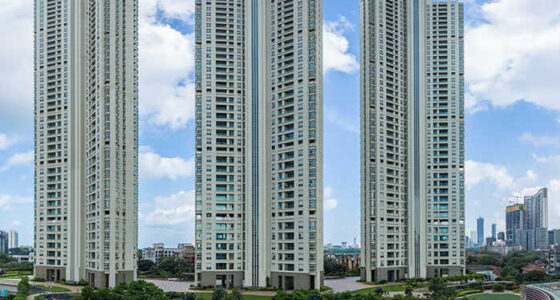

Global economic uncertainty may be causing foreign investors to pull back from Indian real estate, but that hasn’t slowed the market’s overall growth. A new report by Vestian reveals that domestic investors have stepped up in a big way, keeping the sector’s momentum strong and ensuring developers continue to have access to fresh capital.
Despite a small quarterly dip of just 2%, institutional investments in Indian real estate reached USD 1.76 billion in Q3 2025, the highest third-quarter inflow in four years. This marks an impressive 83% increase compared to last year, a sign of growing investor confidence in India’s property market.
💼 Indian Money Keeps the Market Moving
While foreign capital flows have slowed down, Indian institutional investors and co-investments (where domestic and foreign players jointly fund projects) have surged sharply.
- The share of domestic investments rose to 51% in Q3 2025, a jump of 115% year-on-year.
- Co-investments now account for 41% of total inflows, up from just 15% a quarter ago.
- Foreign investment, on the other hand, dropped to a yearly low of 8%, compared to 46% in Q3 2024.
Experts say this reflects a power shift in who funds India’s growth story. “While foreign investors are cautious amid global headwinds, the rise in domestic and co-investments shows how confident Indian investors are about real estate’s long-term potential,” said Shrinivas Rao, CEO of Vestian.
🏢 Commercial Real Estate Leads the Way
The commercial property segment—which includes offices, retail, co-working, and hospitality—remains the biggest magnet for investors, commanding 79% of total institutional inflows.
Investments in this segment rose 104% year-on-year to nearly USD 1.4 billion, underscoring India’s position as a stable hub for corporate leasing and global capability centers (GCCs).
Developers focusing on Grade A office spaces, flexible workspaces, and retail centers are expected to benefit most from this trend.
🏠 Residential Investments Ease, But Demand Stays Strong
The residential sector saw a short-term dip, attracting USD 192 million, or 11% of total investments, down from 21% in the previous quarter. However, this still marks a 6% annual rise—showing that while investors are more selective, they remain optimistic about housing demand.
For homebuyers, this means developers are likely to maintain construction pace, backed by stable domestic funding rather than foreign capital. Affordable and mid-income projects, which rely less on offshore money, will continue to progress steadily.
🏭 Warehousing and Industrial Sector Gathers Steam
Institutional investment in industrial and warehousing rose 168% over the previous quarter, reaching USD 85.8 million.
The demand for logistics parks and storage infrastructure is being driven by e-commerce growth and manufacturing expansion under Make-in-India, giving investors a new growth story beyond offices and housing.
📊 What This Means for Homebuyers and Developers
- No slowdown in project funding:
With Indian investors filling the gap left by foreign funds, developers can continue to raise capital for ongoing and new projects. - Stable housing prices likely:
Since money flow remains steady, property prices are expected to stay stable rather than surge due to financing shortages. - Domestic confidence growing:
More Indian institutions backing real estate reflects long-term trust in the market’s fundamentals — a reassuring sign for homebuyers. - More regional and mid-size developers to benefit:
Domestic capital often looks for diversified opportunities, which could help mid-tier builders in Tier 2 and Tier 3 cities secure financing more easily.
💬 Expert View
“Indian investors are showing tremendous confidence in domestic real estate,” said Shrinivas Rao, FRICS, CEO, Vestian.
“Even as global uncertainty makes foreign funds cautious, the strong participation of Indian capital ensures liquidity, stability, and continued growth across asset classes.”
⚙️ The Bottom Line
While global uncertainty has made foreign investors cautious, India’s real estate story is now powered by local confidence.
For homebuyers, this means project deliveries will stay on track and the market will continue evolving with more Indian money driving development — a healthy sign of self-reliance and sectoral maturity.