

Revenue Minister Chandrashekhar Bawankule on Tuesday highlighted a key provision under the Registration Act, 1908 that keeps the registration fee for certain family property transfers at a nominal ₹200. Sharing the official notification on X, he described it as major relief for transfer of family property, making the process more convenient, cost-effective and citizen-friendly while saving expenses for common people.
The notification (No. RGN-2016/51/CR-11/M-1), issued by the Revenue & Forest Department on 31 March 2016 and effective from 1 April 2016, amends the Table of Fees originally published in 1961. It adds Note 59: “With effect from 1st April, 2016 registration fee payable on the instrument of Gift of residential and agricultural property in favour of husband, wife, son, daughter, grand-son, grand-daughter or wife of deceased son shall be Rs.200.”
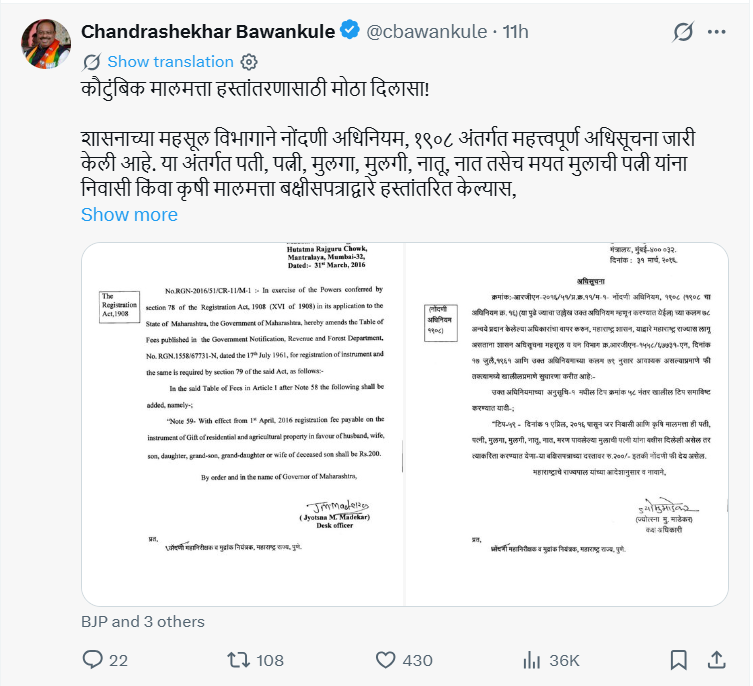
This applies only to gift deeds of residential or agricultural property transferred to the specifically listed relatives (spouse, children, grandchildren, or widow of a deceased son). Commercial property or gifts to other relatives (siblings, parents in the reverse direction in some cases, or distant family) do not qualify for this fixed registration fee.
Earlier Fee and the Relief
Before this amendment, registration of gift deeds (like most conveyances and similar instruments under Article I of the Table of Fees) was charged on an ad-valorem basis. The scale was roughly ₹100 for values up to ₹10,000, plus ₹10 for every additional ₹1,000 or part thereof, subject to a maximum of ₹30,000. For higher-value properties this effectively worked out close to 1% of the market value (capped at ₹30,000). The 2016 change fixed the registration fee at a flat ₹200 for the eligible family gifts of residential/agricultural property — a substantial reduction that remains in force.
Important distinction: This notification deals only with the registration fee under the Registration Act, 1908. Stamp duty is governed separately by the Maharashtra Stamp Act. For the same category of residential/agricultural gifts to the listed close relatives, stamp duty is also a concessional flat ₹200 (introduced via earlier amendments around 2015). For other gifts the stamp duty is typically 3% of market value (Ready Reckoner). In many urban areas additional levies such as metro cess or local body tax (LBT) may still apply on top of these base amounts; rates and applicability should always be verified with the local Sub-Registrar or the IGR Maharashtra portal before execution.
Practical Impact for Homebuyers and Families
The combined low stamp duty + registration fee structure makes intra-family transfers of homes or farmland far cheaper than a sale deed (which attracts full conveyance rates of 5–7%+ depending on location and gender of the buyer, plus registration). Families commonly use gift deeds for succession planning, transferring property to children or spouses without the higher costs and formalities of a sale. Once properly executed, accepted by the donee, and registered, a gift of immovable property is generally irrevocable under the Transfer of Property Act (except on limited grounds such as fraud).
Registration remains mandatory for the transfer of immovable property to be valid. The process typically involves drafting a proper gift deed (with clear description of the property, voluntary intent, and acceptance), payment of the applicable stamp duty and registration fee (online via GRAS where available), appearance before the Sub-Registrar with witnesses, and subsequent mutation of records.
While the minister’s post has drawn attention to the provision, it is not a fresh notification issued in 2026 — the relief has been available since April 2016 and continues to apply. Citizens and professionals should rely on the current Table of Fees and confirm local cesses, as secondary sources sometimes conflate stamp duty and registration charges or quote the general 1% registration rate without noting the specific family-gift exemption.
This longstanding concessional regime supports easier, lower-cost transfer of family property and remains one of the more citizen-friendly features of Maharashtra’s property registration framework.