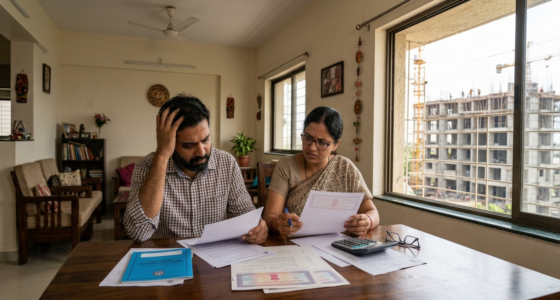
In a ruling that brings significant relief to homebuyers struggling to recover money from deceased builders, the State Consumer Disputes Redressal Commission, Mumbai, has held the legal heirs of a builder personally accountable for their father’s dues. The Commission dismissed the challenge filed by the daughters and cleared the path for attachment of their residential flats in Vashi, Navi Mumbai.
The order was passed on 11 August 2026 by Justice S. P. Tavade (President) and Member Vijay C. Premchandani in Appeal Execution No. SC/27/AE/31/2026. The Commission refused to protect the properties of the legal heirs and upheld the recovery proceedings initiated after the builder’s death.
Background of the Case
The original complainant, Shainand Shrishail Thombare, had paid ₹4.40 lakh for a flat in an upcoming project of the late Shailesh Dawda at Vihighar, Panvel. When the project failed and the refund was not paid, the consumer complaint was allowed against the builder.
After Shailesh Dawda’s death, the complainant filed Execution Application No. 05/2021 before the Additional District Consumer Commission, Thane. The District Commission issued a Recovery Certificate under Section 71 of the Consumer Protection Act, 2019. Acting on this certificate, the Tehsildar-cum-Executive Magistrate, Thane, issued a possession notice dated 5 February 2026 seeking to take over the flats owned by the builder’s daughters.
The Flats in Question
The properties sought to be attached are Flat No. 101 and Flat No. 102 at Daffodils Annex Co-operative Housing Society Ltd, Plot No. 1/2, Sector 14, Vashi, Navi Mumbai – 400703. These are residential flats in a cooperative housing society in a prime locality of Navi Mumbai.
The flats were originally purchased by the builder’s wife, Padma Dawda, through an Agreement for Sale in 1995. In 2022, after the consumer order had been passed and recovery proceedings had begun, she executed a gift deed transferring both flats to her daughters, Prerana Dawda and Tanya Dawda.
What the Daughters Argued
Prerana and Tanya Dawda challenged the recovery proceedings and the Tehsildar’s notice before the State Commission. Their main arguments were:
- They are absolute owners of the Vashi flats through the gift deed from their mother and did not inherit any property from their late father.
- Their personal assets cannot be attached for the father’s liabilities.
- The action violates Section 50(2) of the Code of Civil Procedure and Article 300A of the Constitution.
- They cannot be treated as legal representatives for the purpose of personal liability.
They also contended that the District Commission could not bypass the safeguards available under Order 21 of the CPC while enforcing the decree.
The Legal Position Under Section 50 of the CPC
The State Commission examined Section 50 of the Code of Civil Procedure, which governs the liability of legal representatives. The provision states:
“(1) Where a judgment-debtor dies before the decree has been fully satisfied, the holder of the decree may apply to the Court which passed it to execute the same against the legal representative of the deceased.
(2) Where the decree is executed against such legal representative, he shall be liable only to the extent of the property of the deceased which has come to his hands and has not been duly disposed of; and, for the purpose of ascertaining such liability, the Court executing the decree may, of its own motion or on the application of the decree-holder, compel such legal representative to produce such accounts as it thinks fit.”
The Commission held that the burden was on the daughters to prove that they had not inherited any property from their father. They failed to produce any such evidence.
Why the Gift Deed Failed to Protect the Flats
The Commission observed that Padma Dawda, being the legally wedded wife of the deceased builder, was herself a legal heir and representative. The gift deed executed by her in 2022 — after the consumer order and during recovery proceedings — was viewed as an attempt to avoid attachment and defeat the rights of the decree-holder.
Once the mother was treated as a legal heir, the daughters who received the property from her were also regarded as legal heirs through her. Revenue records (7/12 extracts and mutation entries) further showed the daughters’ names linked to properties of the deceased. A will allegedly executed by the father in favour of the mother (registered after his death) was also noted with suspicion regarding its genuineness.
Recovery Proceedings Upheld
The State Commission ruled that the Recovery Certificate issued by the District Commission under Section 71 of the Consumer Protection Act, 2019, read with Order 21 of the CPC, was valid. It further held that the Tehsildar’s actions under the Maharashtra Land Revenue Code could not be challenged through the present revision petition.
Any objection regarding the title of the flats should have been raised before the revenue authorities. The daughters had not done so.
Final Order
The Appeal Execution was dismissed with no order as to costs. Certified copies of the order were directed to be provided free of charge to both parties.
Relief for Homebuyers
The ruling sends a strong message that legal heirs of builders cannot easily escape liability after the promoter’s death by transferring properties through gift deeds. Courts are prepared to look at the timing and substance of such transfers when the hard-earned money of homebuyers is involved.
For homebuyers chasing recovery against deceased builders, this order provides important clarity that properties held by legal representatives can be proceeded against, subject to the limits under Section 50(2) of the CPC.
Also Read: MahaRERA’s Conciliation Forum Redresses 1,749 Complaints