A Navi Mumbai shop owner who allowed a couple to use his APMC Market gala for two short stretches of 11 months each has finally secured an order to take it back — 32 years after the last licence expired. The Bombay High Court has held that the occupier was only a licensee, not a protected tenant, dismissed her writ petitions, directed her to vacate by 30 September 2026, and ordered a fresh enquiry into mesne profits from August 1996 instead of the token ₹2,000 a month fixed two decades ago.
Justice Sandeep V. Marne delivered the common judgment on 10 September 2026 in Writ Petition Nos. 7067 and 7068 of 2003, Navina Dinesh Shetty v. Shaikh Ayub Rehman. The petitions challenged a 2003 District Court decree that had already reversed a Trial Court finding of tenancy.
How a 22-month arrangement became a 32-year fight
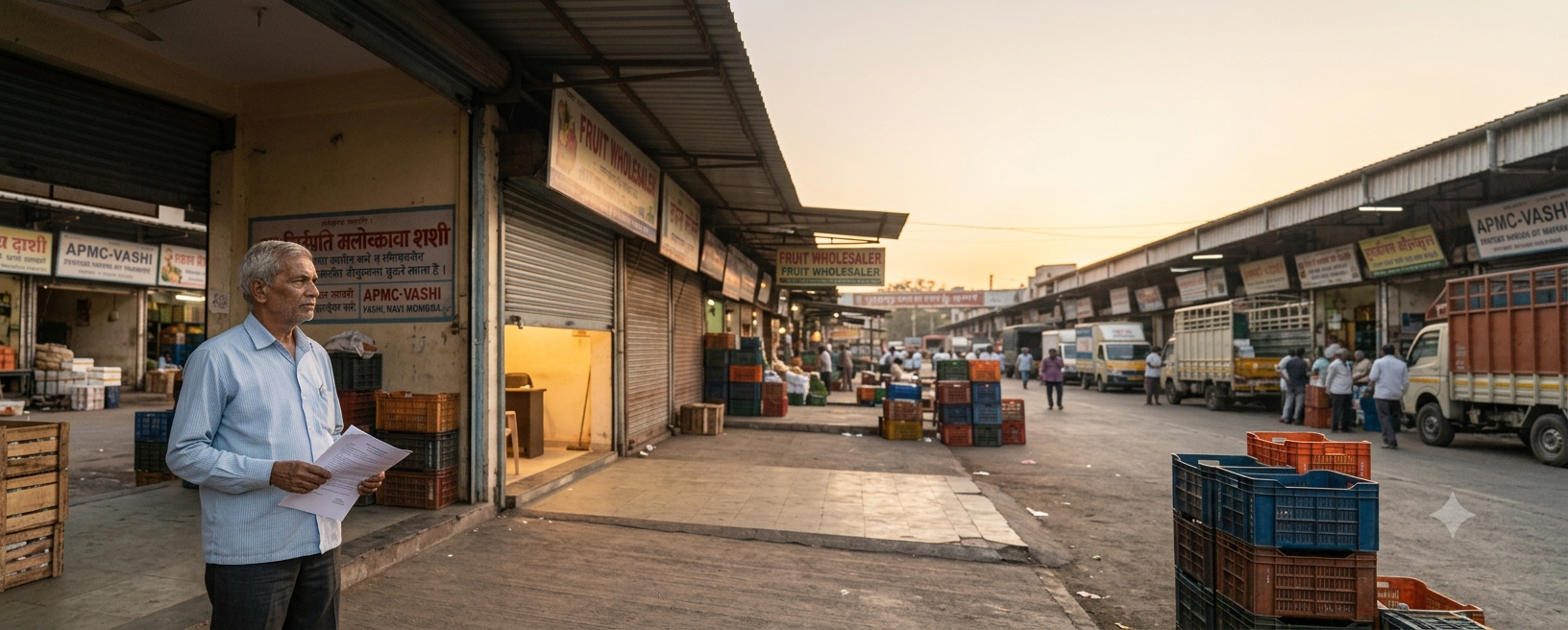
The premises are Shop/Gala No. 9 on Plot No. 50, APMC Market, Sector 19, Vashi. They belong to Shaikh Ayub Rehman. Navina Dinesh Shetty and her husband, K. Dinesh J. Shetty, run a restaurant/hotel in the adjoining Gala No. 10. They wanted extra space for expansion.
On 12 October 1994 a document titled “Caretaker Agreement” was executed in the husband’s name. It granted “permission and licence” from 15 October 1994 to 14 September 1995. Compensation was ₹1,800 a month; ₹19,800 was paid upfront for the full 11 months. A receipt called the amount “eleven months rent.”
When that term ended, a second, almost identical Caretaker Agreement was signed on 15 September 1995 — this time in Navina Shetty’s name — from 15 September 1995 to 14 August 1996.
Both documents repeatedly used the language of licence and permission. They said the owner would remain in control, dominion and possession, that the occupier’s use was not exclusive, that the occupier would quit at the end of 11 months, and that the licence could be revoked on notice. They also used the word “rent” in a few places. Clause 5 was internally contradictory: the first part said the agreement created no interest or estate as tenant; the second part said the relationship “shall always be landlord and tenant.”
Shetty later argued that the word “rent,” Clause 5, the use of the premises for a hotel, and Section 105 of the Transfer of Property Act together meant the parties had created a tenancy.
Cross suits in Vashi, two opposite findings
In 1997 she filed Regular Civil Suit No. 553 of 1997 before the Civil Judge Junior Division, Vashi, seeking a declaration that she was a tenant and an injunction against dispossession without due process.
The owner filed Regular Civil Suit No. 61 of 1998 seeking possession on the ground that the licence had expired and she was only a licensee.
On 22 January 2002 the Trial Court decided both suits separately. It decreed her suit, declared her a tenant and granted a perpetual injunction. It dismissed the owner’s possession suit. The court treated three tests as enough for a lease: right to enjoy immovable property, a specified period, and valuable consideration.
The owner appealed. Civil Appeal Nos. 51 and 52 of 2002 were heard by the Additional District Judge, Thane. By a common judgment dated 10 September 2003 the Appellate Court reversed both Trial Court decrees. It held Shetty was a mere licensee, dismissed her tenancy suit, decreed the owner’s suit, directed her to hand over possession within two months, and ordered her to pay ₹2,000 a month from 14 August 1996 till delivery of possession. The Appellate Court cut the owner’s claim of ₹4,000 a month because there was no evidence that the shop would have fetched that rent at the relevant time.
Twenty-three years in the High Court
Shetty challenged that common judgment in the two writ petitions. On 6 November 2003 both petitions were admitted. In WP 7067 of 2003 the High Court stayed the possession decree. During the stay she deposited ₹2,000 a month in the Trial Court only up to September 2012. After that she stopped. The High Court recorded that she had occupied the shop free of cost for about 14 years after that date, and that the total occupation from the first induction in 1994 ran to about 32 years.
The petitions were reserved on 28 August 2026 and pronounced on 10 September 2026.
Why the High Court said it was a licence, not a tenancy
Justice Marne held that the documents had to be read as a whole, not by picking the word “rent” or the second half of Clause 5.
The Court found:
- The title, recitals and operative clauses granted only permission and licence for 11 months.
- The owner retained control, dominion and possession; the occupier did not have exclusive possession.
- The occupier agreed to quit at the end of the term.
- After the first 11-month caretaker agreement ended, the parties signed a second identical caretaker agreement instead of treating the husband as a sitting tenant. That conduct, the Court said, left no doubt that both sides treated the arrangement as a licence.
- Mere use of the word “rent” does not create tenancy. The Supreme Court in Suhas Yeshwant Chopde v. Sachhidanand D. Purekar and this High Court in Rajendra B. Nair v. Suresh D. Dyanmothe have already held that “rent” or “compensation” is not conclusive.
- The second part of Clause 5 was a typographical error. If the parties had meant tenancy they would not have used “Caretaker Agreement,” limited the term to 11 months, or reserved possession with the owner.
On Section 105 of the Transfer of Property Act, the Court held the first condition of a lease — transfer of a right to enjoy the premises — was not satisfied. A licence under Section 52 of the Indian Easements Act gives only a right to do something on the grantor’s property without creating an interest. Here there was no transfer of interest. Possession stayed with the owner.
The argument that taking the shop to expand a hotel business necessarily meant tenancy was rejected. Intention is gathered from the document and conduct, not from the nature of the business alone.
Stern words for the Trial Court
The High Court said the Trial Court had “egregiously erred” and “completely misdirected itself.” Treating an 11-month caretaker licence as statutory tenancy on a mechanical reading of three tests was described as unfortunate and disquieting.
The judgment warned that such an approach would discourage owners from giving premises on leave and licence, shrink housing and commercial stock available to people who cannot or do not wish to buy, and undermine the leave-and-licence regime under the Maharashtra Rent Control Act, 1999. Section 24 of that Act gives a faster eviction route against licensees and allows recovery of double the licence fee as a deterrent for overstay. If owners fear that a short licence will be converted into protected tenancy, they will stop offering premises at all — harming both owners and genuine licensees.
The mesne profits twist
The fight did not end with possession. Counsel for the owner asked the High Court to use Order 41 Rule 33 of the Code of Civil Procedure to replace the Appellate Court’s ₹2,000-a-month direction with an enquiry into mesne profits from 14 August 1996.
Shetty’s counsel objected: the owner had prayed for ₹4,000 a month; the District Court had already adjudicated that prayer and granted only ₹2,000; if the owner was unhappy he should have challenged that part of the decree.
The High Court held it could still act. Because of Section 7 of the CPC, a challenge to this kind of Small Causes jurisdiction decree comes under Article 227 rather than a revision under Section 115. Even so, the Court held that Order 41 Rule 33 and related CPC powers can be used in an Article 227 petition. It relied on M/s. Musaji Mohamadali Master and Sons, Puran Singh, Prabhulal Chhogalal, Banarsi v. Ram Phal, Narayanrao v. Sudarshan and Sattarsha Dibarsha. A respondent can attack an adverse finding even without a formal cross-objection; the Court can pass the decree that ought to have been passed to do complete justice.
Possession after 14 August 1996 was unauthorised. Mesne profits under Section 2(12) CPC are the profits the person in wrongful possession actually received or might with ordinary diligence have received, plus interest, excluding profits from the wrongful occupier’s own improvements. Order 20 Rule 12 allows a decree for possession plus an enquiry into mesne profits till delivery.
The High Court therefore set aside operative direction No. 5 of the 2003 Appellate Court decree (the ₹2,000-a-month order) and directed the Trial Court to hold an enquiry into mesne profits from 14 August 1996 till actual handover, and to make Shetty pay the amount so determined.
What the High Court finally directed
- Both writ petitions are dismissed.
- Navina Dinesh Shetty shall hand over possession of Gala No. 9 on or before 30 September 2026.
- The Appellate Court’s direction to pay ₹2,000 a month stands modified. The Trial Court shall enquire into mesne profits under Order 20 Rule 12 CPC from 14 August 1996 till possession is given, and she shall pay that amount to the owner.
- No order as to costs.
For the owner, the legal recognition that the occupier was never a tenant has come after a licence meant for 22 months, two suits, two appeals, a 23-year writ, deposits that stopped in 2012, and more than three decades of occupation of a commercial gala in a busy Vashi market. The next stage is not another debate on tenancy. It is an enquiry into what that shop was actually worth in the market for every month of unauthorised occupation since August 1996.
Also Read: Builder waives retail lease rentals because of lockdown