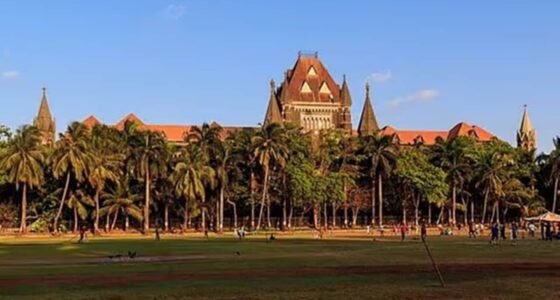

In a judgment that reads as much like a detective story as a legal ruling, the Bombay High Court has seen through an elaborate obstruction scheme and handed a Mumbai landlady her long-overdue victory — ordering that she finally get possession of a room in Jamset Building, Jacob Circle, Mahalaxmi, that has been stuck in litigation since 2009.
Justice Sandeep V. Marne, pronouncing the judgment on April 22, 2026, pulled back the curtain on what he described as a man running litigation “from behind the curtains” through his niece, using her as a front to frustrate a valid eviction decree. The judge did not mince words, calling the Appellate Court’s order “indefensible” and observing that allowing it to stand would amount to “assisting the Defendant in his nefarious designs.”
The Landlady, the Sub-Tenant, and a Decree That Gathered Dust
The story begins in 2009, when Gool Rusi Vatcha, the owner of Jamset Building, filed an eviction suit against her tenant Yusufali Danawalla and his sub-tenant Kalam Khan for Room No. 15 on the third floor of the building. Danawalla never appeared to contest the suit. Khan did, claiming he had been living with the original tenant as a distant relative and had even paid Rs. 2 lakhs to the landlady’s Constituted Attorney (CA) for transfer of the rent receipt — though no receipt was ever transferred. The Small Causes Court decreed the eviction in September 2011 on grounds of unlawful subletting and the landlady’s bona fide need.
Then, remarkably, the landlady waited. Eleven years passed before she filed an execution application in 2022. When she finally moved to take possession, what followed was a masterclass in litigation delay — one that would ultimately fail when it reached the Bombay High Court.
The Undertaking That Gave the Game Away
When the execution application was filed in 2022, Kalam Khan appeared before the Executing Court in January 2023 — very much alive to the proceedings and very much claiming possession of the flat. He signed an undertaking agreeing to pay the landlady Rs. 46 lakhs: Rs. 40 lakhs as a lump sum, Rs. 1 lakh in rent arrears, and Rs. 5 lakhs towards advocate fees, in exchange for recognition of his tenancy. He also specifically undertook that he would not induct any third party into the premises.
He paid nothing. He stopped attending court. And then, exactly 27 days after signing that undertaking, his niece Naziya Wasim Shaikh walked into court and filed Obstructionist Notice No. 43 of 2023 — claiming that she, not Kalam Khan, was in possession of the flat and had independent rights over it.
The timing alone, as the High Court would later note, told its own story.
Naziya’s Version of Events
Naziya’s claim was dramatic. She said she had been living in the flat since 2002, first with Kalam Khan, then separately after her marriage in 2007, and then back in the flat from 2010 onwards after separating from her husband, with her young son.
She claimed that after the 2011 eviction decree, the landlady’s CA had approached her with a proposal: pay Rs. 10 lakhs and the tenancy would be transferred to her name. She said she agreed, paying Rs. 10,000 every month from January 2012, clearing the full amount by January 2022. She produced a detailed schedule of payments running across ten years.
She then claimed the CA shifted the goalposts — suddenly demanding Rs. 50 lakhs more, threatening to throw her and her child out if she didn’t comply. She alleged that the landlady and Kalam Khan were in collusion — that Khan had colluded with the landlady to get a decree passed, then given up possession to her, making the decree a tool to evict her rather than him.
It was a compelling story. The Appellate Court believed enough of it to send the matter back for a full trial.
The Cracks in the Story
The Trial Court had dismissed Naziya’s application outright in May 2023, imposing costs of Rs. 5,000 on her. The Appellate Court reversed this in November 2025, holding that Naziya deserved a chance to prove her payment of Rs. 10 lakhs through evidence. It was this reversal that the landlady challenged before the High Court.
Justice Marne went through the record with care, and found the cracks in Naziya’s account to be fatal.
First, the payment story did not survive scrutiny alongside Kalam Khan’s own undertaking. In January 2023, Khan claimed exclusive possession of the flat and undertook to pay Rs. 40 lakhs for tenancy recognition. If Naziya had been paying the landlady’s CA since 2012 and had cleared Rs. 10 lakhs by 2022 — with Khan’s knowledge and involvement, as she claimed — why would Khan turn up the very next month claiming exclusive possession and offering a completely separate Rs. 46 lakhs? Both versions could not simultaneously be true.
Second, and more damaging, was where Kalam Khan kept turning up. When the bailiff arrived at the flat in March 2024 to serve a possession warrant, he found Khan there. Khan told the bailiff he was the sole occupant. A photograph was produced in court showing Khan accepting service of the warrant — not a casual visitor, but a resident. In March 2024, Khan also filed a court application stating he “resides with the obstructionist as a family member.” In July 2024, he filed yet another application, claiming he was never served with the original suit summons — a claim the court noted was demonstrably false since he had filed a written statement in the suit. As recently as March 2026, when the present writ petition was served at the flat, Naziya accepted the notice — for both herself and Kalam Khan.
The court also noted that Naziya had suppressed the fact that she was Khan’s niece in her obstruction application, and that her name appeared in his ration card.
The High Court’s conclusion was blunt: Naziya did not possess the flat independently of Kalam Khan. She had entered through him, she lived with him, and she had no rights separate from his. Since Khan himself had no legal rights — having been found to be an unlawful sub-tenant in 2011 — Naziya’s claim of independent rights had no foundation whatsoever.
The Legal Question: Does Every Obstruction Need a Full Trial?
Beyond the facts of this particular dispute, the judgment settles an important legal point about execution proceedings.
Order 21 Rule 97 of the Code of Civil Procedure allows a third party to obstruct execution of a decree by claiming independent rights. Rule 101 requires the court to determine “all questions” arising from such an application. The Appellate Court read this to mean that Naziya was entitled to a full trial to prove her claim.
Justice Marne disagreed, relying on the Supreme Court’s judgment in Silverline Forum Pvt. Ltd. vs. Rajiv Trust (1998) and an earlier Bombay High Court ruling in Indubai D. Kothawale vs. Laxman Balwant Chougule (2023). The law, he held, does not require a full-fledged trial in every obstruction case. Where the Executing Court is satisfied that the obstructionist has no semblance of a legal right, it can conduct a summary inquiry and reject the application at the threshold. To hold otherwise would be to hand every unscrupulous occupant a tool to delay valid decrees indefinitely, simply by filing an obstruction and demanding a trial.
Rule 101, the judge held, is designed to prevent multiplicity of proceedings — not to create an avenue for baseless claims to be litigated like full suits.
The Appellate Court Gets a Sharp Rebuke
The Appellate Court did not escape the High Court’s scrutiny unscathed. Justice Marne noted that while the Appellate Court’s order ran to 18 pages, its actual reasoning occupied barely two pages, most of which he found “grossly perverse.”
The Appellate Court had flagged what it saw as inconsistency in the Trial Court’s findings — that Defendant No. 2 could not simultaneously be in exclusive possession while Naziya’s documents showed her residence. The High Court disposed of this cleanly: whether Khan lived there alone or with Naziya was irrelevant. The question was whether Naziya lived there to the exclusion of Khan — and she admittedly did not.
The Appellate Court had also laid weight on the landlady’s 11-year delay in executing the decree. The High Court dismissed this as “totally irrelevant” to the question of Naziya’s independent rights.
Most pointedly, the High Court observed that the Appellate Court had “failed to lift the veil” — that it had allowed its jurisdiction to be abused by Naziya and Khan, and that upholding its order would have rewarded Khan’s “nefarious designs” by allowing him to continue occupying the premises under the cover of his niece’s obstruction.
The Final Order
The Bombay High Court allowed the writ petition, set aside the Appellate Court’s order dated November 27, 2025, and restored the Trial Court’s original order of May 6, 2023 dismissing Naziya’s obstruction. No costs were imposed by the High Court.
After 15 years of litigation — a suit filed in 2009, a decree in 2011, an execution attempt in 2022, and three rounds of court proceedings — the landlady can finally take possession of Room No. 15, Jamset Building.
Also Read: Man wants to sell Kidney, not for an iPhone but to pay deposit to Landlord