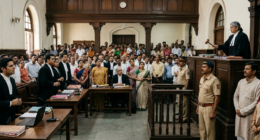
In a setback for a group of alleged members of a co-operative housing society linked to the Slum Rehabilitation Authority (SRA) in the Pimpri-Chinchwad area, the Bombay High Court has dismissed their writ petition challenging a provisional voters’ list for society elections. The court ruled that the petitioners bypassed the available alternative remedy and that the core dispute involves factual questions requiring evidence, which cannot be resolved in writ jurisdiction under Article 226 of the Constitution.
The petitioners, led by Ketan Govind Jadhav and others, approached the High Court claiming irregularities in the provisional voters’ list published on January 31, 2026, by the Authorized Officer/Election Officer. They alleged that the society originally had only 23 members, but the list inflated the figure to 61, potentially allowing ineligible persons to participate in upcoming society elections or related decisions.
Chronological Sequence of Events
- Pre-January 2026: Disputes arose among members of Respondent No. 3 (the co-operative society, under SRA oversight in Pune/Pimpri-Chinchwad) regarding membership validity. Petitioners claimed the society was limited to 23 original members, while others argued for expanded membership, possibly tied to slum rehabilitation allotments or redevelopment processes common in SRA projects.
- January 31, 2026: The Authorized Officer published the provisional voters’ list for society elections. The accompanying notice explicitly provided a remedy — interested parties could file objections on or before February 9, 2026, to address any errors, inclusions, or exclusions.
- February 3, 2026: Instead of filing objections with the Authorized Officer, the petitioners directly filed Writ Petition No. 1914 of 2026 in the Bombay High Court, seeking to quash the provisional list. In their petition (Paragraph 7), they asserted no alternative or equally efficacious remedy existed.
- March 6, 2026: The matter came up for hearing before a Division Bench comprising Justices A.S. Gadkari and Kamal Khata. Advocates representing the parties — Mr. Sumant R. Deshpande for petitioners, Ms. Pooja Patil (AGP) for state respondents, Mr. Vishwanath Patil for Respondent Nos. 2 & 3 (society-related), and Mr. Deepak R. More for Respondent No. 4 — were heard.During arguments, the court queried why objections were not raised as per the notice. Petitioners’ counsel admitted no objections had been filed, nor had any defects been pointed out to the officer.The bench scrutinized sample membership forms but noted the membership count (23 vs. 61) was a disputed fact needing evidence from both sides, including legally admissible proof.
- March 6, 2026 (Order Pronounced): The court dismissed the petition, holding:
- An alternative remedy existed via objections (rejected petitioners’ claim of no remedy).
- Petitioners failed to exhaust it, rushing to court prematurely.
- Core issues were factual disputes unsuitable for writ jurisdiction, as High Courts do not conduct mini-trials without evidence.
- Other factual controversies in the petition also required full evidentiary adjudication.
Implications and Next Steps
The dismissal underscores judicial emphasis on due process in co-operative society elections under Maharashtra laws. Such disputes often arise in SRA-linked societies amid redevelopment stakes, where membership control influences project approvals, flat allotments, and funds.
Petitioners may still pursue remedies by approaching the Authorized Officer (if time permits), the Assistant Registrar of Co-operative Societies, or filing a civil suit/appropriate proceeding for detailed fact-finding. Society elections or related processes can proceed unless stayed elsewhere.
Legal experts note this aligns with settled law: writ petitions are not substitutes for statutory remedies or fact-based trials.
Also Read: Smart Home IQ: How AI is Enhancing Intelligent Recommendations for Homeowners