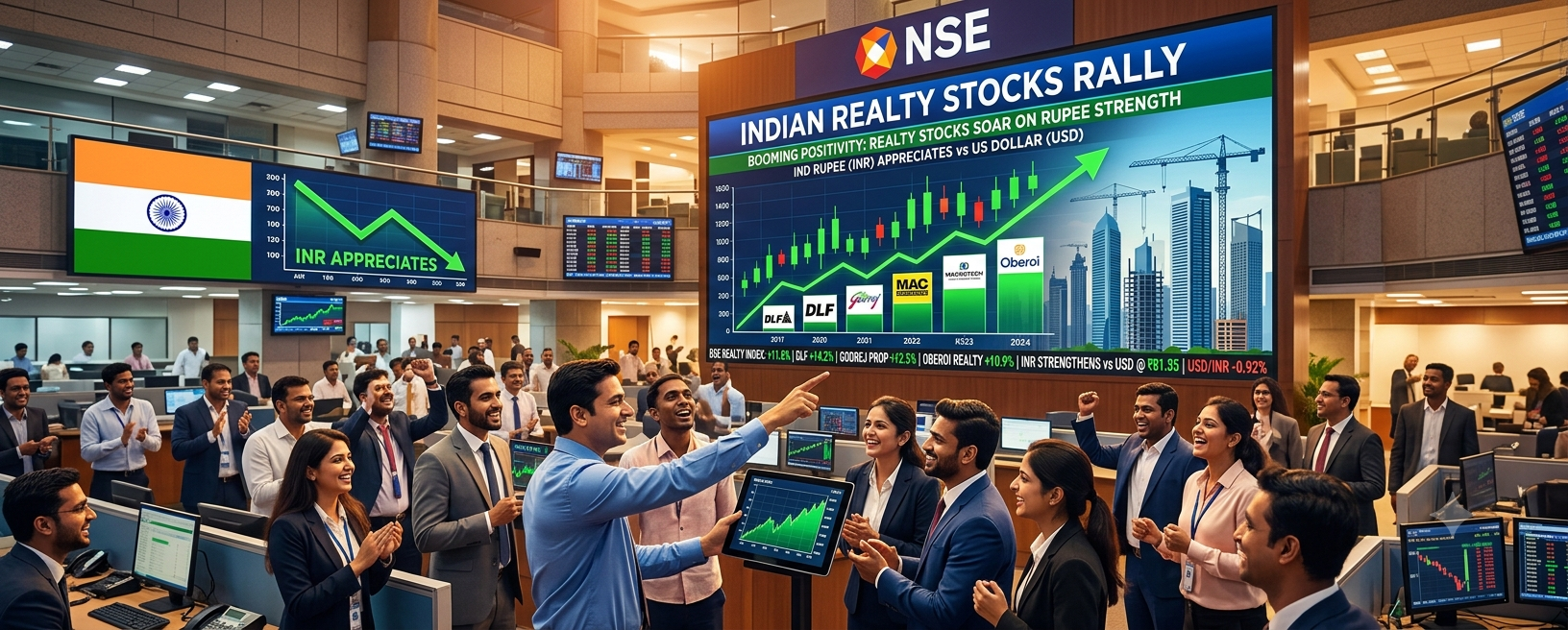

Thursday September 3 has delivered the morning the realty sector needed after two of the most painful opening sessions of the month. US President Donald Trump played down the prospect of a prolonged conflict with Iran — a single statement from Washington that has done more for market sentiment this morning than any diplomatic process has managed in weeks. The Sensex gained 154.6 points or 0.20% to start the session at 76,724.95. The Nifty opened with a jump of 83.5 points to 23,997.95. The rupee opened 69 paise stronger against the dollar — its best level in over two months. GIFT Nifty opened with a gain of 146.5 points at 24,111.50. And crucially, FIIs bought equities worth ₹6,688.37 crore on Tuesday September 1 while DIIs also bought ₹2,812.98 crore — the joint institutional buying signal the sector has been waiting for since August’s volatility resumed.
The Peg: Trump Steps Back From the Brink. The Rupee Moves First. The Sector Follows.
Currency markets are the fastest financial markets in the world — they price geopolitical signals before equities, before bonds, before commodities. So when the rupee opens 69 paise stronger at its two-month high, it is telling a specific story: that Donald Trump playing down the prospect of a prolonged Iran conflict is being taken seriously in currency trading rooms from Singapore to London, and that the risk premium on India’s crude import bill is being removed in real time.
The sequence matters. Trump’s statement — that the conflict with Iran may not be prolonged — has arrived three days after his Kharg Island threat had sent the market into a two-session selldown. The reversal of that threatening posture is not a peace deal. It is not the Hormuz joint statement’s operational implementation. It is one presidential statement that reduces the tail risk of a catastrophic military escalation against Iran’s oil export infrastructure. But for a market that had been pricing in that tail risk through crude at $90 and a Nifty at 23,846, one de-escalation statement from Trump is enough to shift the daily direction entirely.
For the realty sector, which has been the most consistent expression of the crude oil-Iran peace thesis throughout CY26, Thursday’s open is a direct mechanical positive. A rupee 69 paise stronger means India’s crude import bill in local currency is lower. Lower import costs ease inflationary pressure. Eased inflationary pressure reduces the RBI rate hike probability that Warsh’s Jackson Hole speech had revived. And a reduced rate hike probability is the most direct domestic positive the rate-sensitive realty sector can receive.
How the Realty Sector Is Opening
Market breadth was positive on Thursday, with 1,913 stocks advancing against 425 stocks declining on the NSE — 4.5 advancing stocks for every declining one. That breadth is the clearest possible signal of a genuine relief rally rather than a narrow index-level move driven by one or two heavyweights.
The Nifty Realty index opens Thursday with broad-based buying across all ten constituents — the kind of uniform positive opening the sector last saw on August 24 when the Iran-Oman Hormuz joint statement was published. The sector had fallen 1.06% on Tuesday September 1 as that week’s worst-performing sectoral index. Wednesday’s continued selling had pushed the Nifty Realty index toward 855–865 — its lowest level since before the Hormuz joint statement’s August optimism. Thursday’s open is the sector’s first clear attempt to claw back those losses.
ICICI Bank, Adani Ports, and Axis Bank are the top gainers in the Nifty50 at Thursday’s open. The banking sector’s strength is the realty sector’s most important secondary positive of the morning. A strong banking open means the home loan disbursement channel is being reinforced, not weakened. After HDFC Bank’s 30-month low — driven by CEO Sashidhar Jagdishan’s decision not to seek a third term — had added a secondary headwind to realty sentiment on Wednesday, Thursday’s banking recovery provides the credit market stability signal the sector most needs.
Godrej Properties, whose ₹27,000 crore FY27 presales target and ₹2 lakh crore gross development value pipeline remain the sector’s most ambitious growth narrative, opens Thursday with genuine buying interest as the macro headwinds that had been pressing the stock below ₹2,000 partially ease on Trump’s de-escalation signal. Lodha Developers, whose record ₹5,620 crore Q1 FY27 presales remain the sector’s most powerful fundamental anchor, opens with the combined positive of a stronger rupee and easing geopolitical risk premium. Prestige Estates Projects, whose largest-ever launch pipeline across Hyderabad, Bengaluru, and Mumbai has been generating continued institutional interest, opens with conviction buying. Sobha, Phoenix Mills, Brigade Enterprises, Anant Raj, Aditya Birla Real Estate, and Oberoi Realty all open with a clearly positive tone.
Tech Mahindra, HCL Tech, Infosys, TCS, and IndiGo are the losers at Thursday’s open — confirming that the morning’s sectoral rotation is away from IT and defensives and toward rate-sensitive and domestically-oriented sectors including banking and real estate. That rotation is the most favourable possible sectoral configuration for the realty sector.
What Is Working
Trump’s statement playing down a prolonged Iran conflict is Thursday’s single most important catalyst. His willingness to publicly dial back from the Kharg Island threat — which had been the most alarming escalation signal of the past two weeks — removes the tail risk that had been keeping crude above $90 and the broader market in risk-off mode. It does not resolve the underlying US-Iran tensions or implement the Hormuz joint statement. But it shifts the market’s probability distribution away from catastrophic escalation toward managed tension — and that shift alone is enough to move the rupee 69 paise and the Sensex 154 points at open.
FIIs buying ₹6,688.37 crore on Tuesday September 1 — the largest single-session FII net purchase since the August recovery began — confirms that global institutional investors were already repositioning toward India ahead of Thursday’s de-escalation signal. A market where FIIs are net buyers of ₹6,688 crore while the Sensex is falling is a market where institutional conviction in India’s medium-term story is strong enough to override short-term geopolitical noise. Thursday’s Trump statement gives those institutional buyers the positive confirmation they were waiting for.
The rupee opening 69 paise stronger at its two-month high is the currency market’s endorsement of the de-escalation signal. For the realty sector specifically, a stronger rupee delivers three simultaneous positives — it reduces India’s crude import bill in local currency terms, reduces inflationary pressure, and attracts FII flows into rate-sensitive sector equities. All three of those consequences arrive simultaneously on Thursday morning.
The BSE Midcap Select Index was up and the BSE Smallcap Select Index jumped 0.88% in early trade — confirming that Thursday’s positive mood is reaching across all market capitalisations rather than being confined to large-cap index names. For the realty sector, whose constituents span large-cap names like Lodha Developers and Phoenix Mills and mid-cap names like Brigade Enterprises and Anant Raj, broad-based market breadth is the rising tide that lifts the entire index rather than concentrating gains in two or three stocks.
The MoHUA force majeure RERA extension continues to be the domestic regulatory anchor — protecting all listed developers from RERA default proceedings for war-related delays through its four-month blanket extension. That protection remains intact regardless of Trump’s daily statements or the market’s intraday volatility, and it is the structural cushion that prevents macro-driven selling from becoming fundamental-driven capitulation.
What Isn’t Working
Tech Mahindra, HCL Tech, Infosys, TCS, and IndiGo declining at Thursday’s open is the most persistent secondary headwind for the realty sector even on a positive morning. IT stocks in their third consecutive session of losses means that residential demand sentiment in tech-heavy cities like Bengaluru, Hyderabad, and Pune — where Prestige Estates, Brigade Enterprises, and Sobha have their heaviest exposures — faces a continuing overhang of slower hiring and cautious pay sentiment even as the macro environment improves.
Trump’s de-escalation statement is a presidential communication, not a diplomatic agreement. The same president who threatened Kharg Island on Monday has played down the conflict on Thursday. That volatility of signalling — which has been the defining characteristic of the Trump administration’s Iran policy throughout the conflict — means that Thursday’s positive can be reversed by a single statement, press conference, or military action over any given weekend. The market’s one-day positive response is rational but fragile.
The Nifty50 at 23,987 at Thursday’s open remains fractionally below the 24,000 psychological mark. A close above 24,000 today would be a meaningful technical positive — confirming that the de-escalation signal has been sufficient to restore the market’s psychological floor. A close below 23,900 would suggest that Thursday’s positive open was sold into by institutional investors treating every Trump de-escalation statement with diminishing credibility.
Bajaj Finance and Hindustan Unilever declining at Thursday’s open — despite the broadly positive market breadth — reflect the ongoing Bajaj Finance regulatory overhang and HUL’s Q2 FY27 demand concerns. Both are Sensex heavyweights whose declines limit the index’s upside potential even on genuinely positive macro days.
What to Watch Through the Day
Any fresh Iran statement — from Tehran, Washington, or Oman’s mediation team — is Thursday’s most critical potential development. Trump’s de-escalation signal this morning could be reinforced by an Iranian diplomatic response, or contradicted by an IRGC military action, within hours. Watch for any follow-up from the Iran side through the morning session — a positive Iranian response to Trump’s signal would push crude decisively below $88 and trigger a sector-wide rally extending Thursday’s open through the afternoon.
Crude oil’s intraday direction is the real-time barometer. Brent falling below $88 on Trump’s de-escalation signal would confirm that the energy market is pricing in a genuine reduction in escalation risk. Crude holding above $89 would signal that energy traders are treating Thursday’s presidential statement as noise rather than signal.
The Nifty50’s hold of 24,000 on a closing basis is Thursday’s most important technical checkpoint. A Thursday close above 24,000 would restore the market’s technical foundation and set up a test of 24,200 and 24,400 in Friday’s session.
The rupee sustaining its 69-paise strengthening through the session — rather than giving back gains as the day progresses — is the currency market signal that most directly validates Thursday’s broader positive. A rupee that holds at its two-month high through 3:30 PM confirms that the de-escalation signal is being priced as durable rather than ephemeral.
Within the sector, watch Brigade Enterprises for any Q1 FY27 presales disclosure — the single most anticipated remaining fundamental data point in the sector. A strong presales number from Brigade on a morning when the macro environment has improved would be the perfect combination of company-specific and macro positives — and the catalyst that finally closes the underperformance gap between Brigade and its sector peers.
Thursday September 3 is the morning the realty sector has needed for a week. Trump has stepped back from the brink. The rupee has surged to a two-month high. FIIs bought ₹6,688 crore on Tuesday. The market is opening with 4.5 stocks advancing for every declining one. The sector’s fundamental story — record Q1 FY27 presales, MoHUA RERA protection, structural housing demand — has not changed through a week of macro volatility. Thursday is the day the market begins catching up to where that fundamental story says the sector should be.
Also Read: Realty Stocks Bounce Back at Open as Nifty Recovers