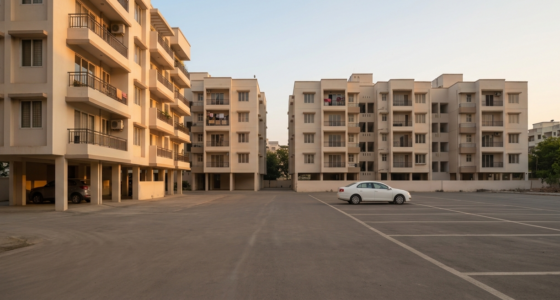

In a significant ruling for Mumbai’s real estate sector, the Bombay High Court dismissed an interim application by Lok Everest Co-Operative Housing Society Ltd., representing 309 flat purchasers, to block Jaydeep Developers from constructing a new wing in the Lok Everest complex in Mulund. The court’s order, pronounced on November 7, 2025, upheld the developer’s right to utilize additional Floor Space Index (FSI) under a 2011 regulatory amendment, citing disclosures made in a 1993 layout plan. The decision has sparked debate about homebuyer protections under the Maharashtra Ownership Flats Act (MOFA) and the implications of delayed legal action.
Background of the Dispute
The case revolves around City Survey No. 661/1/1, where the Lok Everest project includes Buildings No. 4 and 5. The plaintiff society, occupying Building No. 4 with four wings (B1, B2, C1, C2), sought to restrain Jaydeep Developers from constructing Wing C5 of Building No. 5, arguing that the developer had exhausted the FSI disclosed in a 1995 sanctioned plan (22,807.89 sq.m. for Building No. 5 and 67,028.44 sq.m. for the entire layout). The society claimed that additional construction, enabled by a 33% premium FSI introduced in 2011 under the Development Control and Promotion Regulations (DCPR), violated MOFA, which requires 100% consent of flat purchasers for changes beyond the disclosed development potential.
Jaydeep Developers countered that the 1993 layout plan, referenced in flat purchase agreements, disclosed Building No. 5 as having four wings of 16 floors each, including Wing C5, mirroring Building No. 4. They argued that phase-wise development was permitted, and the additional FSI was legally available as the project remained incomplete. The developer also noted that the plaintiff had not objected to prior deviations, such as Building No. 5’s three wings being built with 16 floors instead of the 12 floors indicated in the 1995 plan.
The Court’s Ruling
Justice R.I. Chagla, presiding over the case, ruled that the 1993 layout plan, available for inspection and referenced in the flat purchase agreements, constituted sufficient disclosure under MOFA. The court found that Building No. 5, with only three of its four planned wings constructed, was incomplete, allowing the developer to utilize the additional FSI from the 2011 DCPR amendment. The flat purchase agreements further supported the developer’s right to residual FSI until the entire scheme was completed and societies were registered.
The court rejected the plaintiff’s reliance on a report by M/s Nadkarni & Co., which claimed the 2019 plan’s proposal for three 22-floor wings in Wing C5 violated MOFA, as the report was based on the 1995 plan, not the disclosed 1993 plan. Notably, the developer offered a concession during arguments, agreeing to limit Wing C5 to one 16-floor building, aligning with the 1993 plan, instead of the three 22-floor wings proposed in 2019. The court accepted this concession, dismissing the interim application and vacating a prior undertaking by the developer to halt construction.
The court also highlighted the plaintiff’s delay in raising objections, noting that no challenges were made to earlier deviations, such as additional buildings in the layout or Building No. 5’s altered configuration. The balance of convenience favored the developer, who had invested INR 12 crore in the project, obtained a commencement certificate in 2017, and begun excavation. The court acknowledged potential claims by third-party flat purchasers in Wing C5, which could be adversely affected if construction was halted.
Implications for Homebuyers
The ruling underscores critical lessons for homebuyers in Mumbai’s competitive real estate market:
- Proactive Scrutiny Required: Homebuyers must thoroughly review layout plans and agreements at the purchase stage, as courts may uphold developer rights based on early disclosures.
- Timely Action is Key: The plaintiff’s failure to object to prior deviations weakened their case, emphasizing the need for prompt legal action to challenge unauthorized changes.
- Regulatory Changes Impact Projects: Developers can leverage additional FSI from regulatory amendments if reserved in agreements, potentially altering project layouts and affecting amenities or property value.
- MOFA Protections: While MOFA requires 100% consent for additional construction beyond disclosed plans, prior disclosures and phase-wise development clauses can limit homebuyer recourse.
The court granted a four-week stay on construction at the plaintiff’s request, allowing time for further legal recourse, but the dismissal of the injunction signals a setback for the society’s efforts to halt the project.
Broader Context
The decision comes amid growing tensions between developers and homebuyers in Mumbai, where regulatory changes often lead to disputes over FSI usage and project expansions. Legal experts suggest that homebuyers must be vigilant about developer disclosures and act swiftly to protect their rights under MOFA. “This ruling highlights the importance of understanding the fine print in flat purchase agreements,” said advocate Priya Sharma, a real estate law expert. “Homebuyers need to ensure that all plans are transparent and challenge deviations early to avoid losing leverage.”
The case also touches on the complexities of deemed conveyance, with the court noting that title disputes require separate civil suits, as seen in the upheld 2017 deemed conveyance order for the plaintiff society. With Mumbai’s skyline continuing to evolve, such disputes are likely to persist, raising questions about balancing developer investments and consumer protections.
What’s Next?
The suit remains pending, with title disputes and the developer’s rights to be fully adjudicated at trial. The four-week stay provides the plaintiff society a window to appeal or pursue further remedies. Meanwhile, Jaydeep Developers can proceed with constructing a single 16-floor wing for Wing C5, pending the suit’s final disposal, provided they adhere to the 1993 plan’s specifications.
For Mumbai’s homebuyers, the ruling serves as a reminder to stay informed and proactive in safeguarding their interests in an ever-changing real estate landscape.
Also Read: Bombay High Court: Borrowers Can’t Force Banks to Settle Defaulted Loans