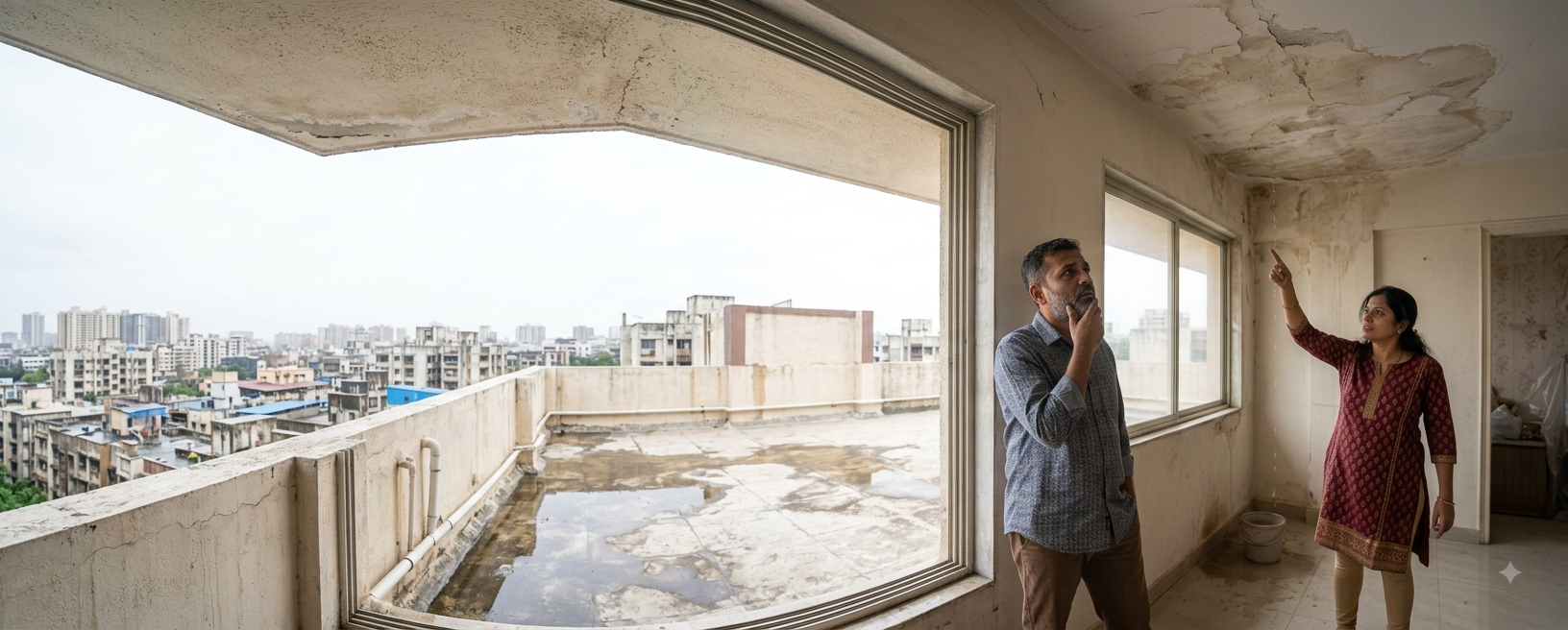

In a significant ruling that reinforces the responsibility of cooperative housing societies for damage originating from common areas, the Co-operative Court No. 3, Mumbai, has held that a society cannot escape liability for repairs to a member’s flat merely by labelling them “internal repairs” when the damage stems from seepage or leakage of rainwater from the terrace.
The judgment, delivered on 10 August 2026 by Judge Smt. V. R. Kulkarni in Dispute No. CC/III/230/2021, came nearly five years after the dispute was registered. The court directed Hirji Baugh Co-operative Housing Society Ltd., Sewree, to carry out the necessary repairs to Flat No. 92 at its own cost within three months.
Background of the Dispute
Sunil Mahadev Dali, a member of the society, occupies Flat No. 92 on the fourth floor of Sumantinath Apartment. The terrace lies directly above his flat. From 2015 onwards, Dali and other members complained of seepage and leakage of rainwater from the terrace that damaged the ceiling of his flat.
When the society failed to take effective action, Dali approached the Assistant Registrar of Co-operative Societies. Multiple proceedings followed. The Assistant Registrar issued directions from time to time for terrace repairs and for addressing the consequential damage to the ceiling of Flat No. 92. A structural engineer appointed by the society, Mr. Manoj V. Sathe, inspected the flat. Later orders of the Assistant Registrar, including one dated 18 January 2021, directed the member to approach the Co-operative Court.
Dali then filed the present dispute under Section 91 of the Maharashtra Co-operative Societies Act, 1960, seeking a direction to the society to repair Flat No. 92 at its cost, or in the alternative, reimbursement of the expenses.
Society’s Defence
The society opposed the dispute on both maintainability and merits. It admitted that complaints had been received and that proceedings had taken place before the Assistant Registrar. It also admitted that directions for terrace repairs were issued and claimed that such repairs were carried out from time to time.
Its core defence was that the leakage and seepage inside Flat No. 92 did not originate from the terrace. According to the society, the work claimed by the member constituted internal repairs for which the member alone is responsible under the applicable bye-laws. The society relied on structural reports, including one obtained from Avon Consulting Engineers, disputed the estimate submitted by the member, and denied any liability either to repair the interior of the flat or to reimburse the amount claimed.
Court’s Findings
The court framed a single principal issue: whether the society is liable to repair Flat No. 92 at its own cost and expenses. It answered the issue in the affirmative.
Key observations of the court include:
- The membership of the disputant and the location of the flat immediately below the terrace were not disputed.
- The disputant’s testimony that the ceiling damage was caused by seepage from the terrace remained unchallenged. The society and its advocate remained absent when the matter was fixed for cross-examination, and an order of no cross-examination was passed. The society also led no oral evidence.
- The society’s written statement itself admitted the history of complaints, the Assistant Registrar’s directions for terrace repairs, the engagement of a structural engineer, and subsequent proceedings. These admissions lent material corroboration to the surrounding circumstances.
- No affirmative evidence was led by the society to establish an independent internal source of leakage inside the flat. A pleading, the court noted, cannot by itself substitute proof of a disputed factual assertion.
- There is a clear distinction between repair of the terrace and repair of the consequential damage already caused to the flat. The society’s claim that terrace repairs were undertaken did not address the unrepaired damage to the ceiling.
Reliance on Bombay High Court Judgment
The court placed significant reliance on the Bombay High Court judgment in M/s. Cosmopolitan-1 (Safal Complex) Co-operative Housing Society Ltd. & Ors. v. Mr. Rakesh Talwar & Ors. (Writ Petition 10183 of 2018, decided on 2 September 2025).
In that case, the High Court examined Model Bye-law 160(a)(xvii) dealing with repairs and maintenance expenditure attributable to leakage of water through the terrace. The High Court held that once the Model Bye-laws are adopted, they must be followed. Expenses that the bye-laws require the society to bear cannot be shifted to terrace-flat owners merely by a resolution of the general body.
Applying this principle, the Co-operative Court held that consequential damage inside a top-floor flat cannot automatically be classified as the member’s private liability merely because the physical manifestation of the damage is inside the flat. Where the damage is attributable to leakage through the society’s terrace or common portion, responsibility follows the source of the damage.
Operative Directions
The court partly allowed the dispute and passed the following order:
- It is declared that the opponent Society is liable to bear the responsibility for the repairs to Flat No. 92 necessitated by the damage caused due to seepage/leakage from the terrace/common portion of the Society’s building.
- The Society is directed to carry out, at its own cost and expenses, such repairs to Flat No. 92 as are necessary to rectify the damage attributable to the said seepage/leakage, within three months from the date of the Award.
- The claim for reimbursement of the quantified amount of Rs. 1,32,263/- was not granted, as the actual expenditure of that amount was not proved by the evidence on record. An estimate of prospective expenditure cannot be equated with proof of expenditure actually incurred.
- Parties were directed to bear their own costs.
Implications
The ruling draws a clear line: societies cannot rely on a general body resolution or a blanket classification of “internal repairs” to shift the cost of damage that originates from the terrace or other common structural portions under their control. The decision is particularly relevant for top-floor flat owners across Mumbai and Maharashtra who frequently face prolonged battles over leakage from terraces.
At the same time, the court was careful not to treat administrative orders of the Assistant Registrar as res judicata and insisted that the factual question of causation must be established on evidence. The refusal to award the quantified monetary claim also underscores that members must prove actual expenditure if they seek reimbursement rather than a direction for repairs.
The judgment, delivered after a delay of nearly five years, once again highlights the long timelines that members face even in relatively straightforward disputes concerning society liability for common-area-related damage.
Also Read: Housing Society Ordered to Pay ₹2 Lakh to Member Over Terrace Leakage